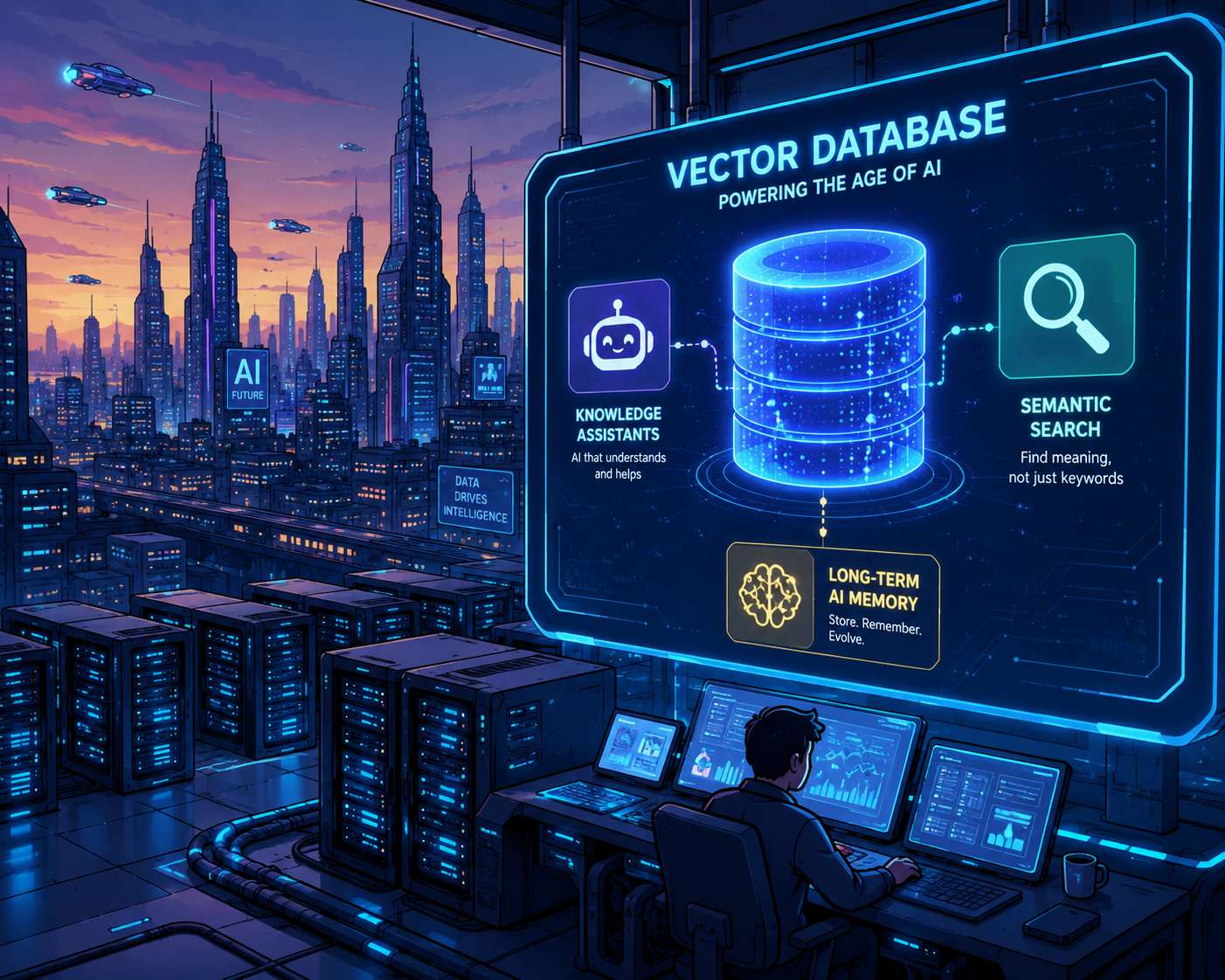
Vector databases have become a crucial component in modern AI systems due to the limitations of traditional SQL search. These databases are now used in various applications such as internal knowledge assistants, semantic search, and long-term AI memory. But what exactly are vector databases, and how do they revolutionize the way we store and retrieve data?
At their core, vector databases use mathematical vectors to represent data, allowing for efficient and scalable storage and retrieval. This is particularly useful in AI applications where high-dimensional data is common. By leveraging the power of vector mathematics, AI vector databases can handle complex data types and relationships with ease.
One of the key benefits of AI vector databases is their ability to support similarity-based search. This allows for more natural and intuitive user interactions, such as searching for images by similarity rather than exact keywords. This is particularly useful in applications like image and video search, where traditional SQL-based search methods would be too limiting.
Another significant advantage of AI vector databases is their ability to handle large amounts of data. As the amount of data available continues to grow exponentially, traditional databases are struggling to keep up. AI vector databases, on the other hand, are designed to handle massive datasets with ease, making them an attractive solution for applications like large-scale recommendation systems and knowledge graphs.
In addition to their technical benefits, AI vector databases are also playing a key role in shaping the future of AI research. By providing a more efficient and scalable way to store and retrieve data, AI vector databases are enabling researchers to focus on more complex and ambitious projects. As a result, we are seeing a new wave of innovation in areas like natural language processing, computer vision, and predictive analytics.
Semantic Retrieval
Imagine you’re searching for a specific recipe online, but you can’t quite remember the exact ingredients or how to prepare it. Traditional search engines rely on keyword matching, which can lead to irrelevant results. That’s where semantic retrieval comes in – a game-changer for finding information that’s conceptually similar.
Vector databases address the problem of semantic retrieval by finding text, images, or code that are conceptually similar. This is achieved by using embedding vectors generated by AI models. In essence, AI vector databases learn to represent complex data in a mathematical space, where similar concepts are closer together.
The main goal is to move beyond keyword matching and find relevant information based on its meaning. For instance, when searching for a recipe, an AI vector database can analyze the context, understand the nuances of cooking, and provide results that are not only relevant but also meaningful. This means finding recipes that use similar ingredients, cooking techniques, or flavor profiles, even if the exact keyword isn’t used.
The power of AI vector databases lies in their ability to capture the essence of complex data. By moving beyond traditional keyword matching, we can unlock new possibilities for information retrieval. Whether it’s finding similar code snippets, images, or text, AI vector databases are revolutionizing the way we search and discover new information.
The implications are vast, from improving search results to enhancing content recommendation systems. With AI vector databases, we can create more intuitive and user-friendly interfaces that understand the context and meaning behind our queries. As AI continues to evolve, we can expect AI vector databases to play an increasingly important role in shaping the future of information retrieval.

Key Players in the Market
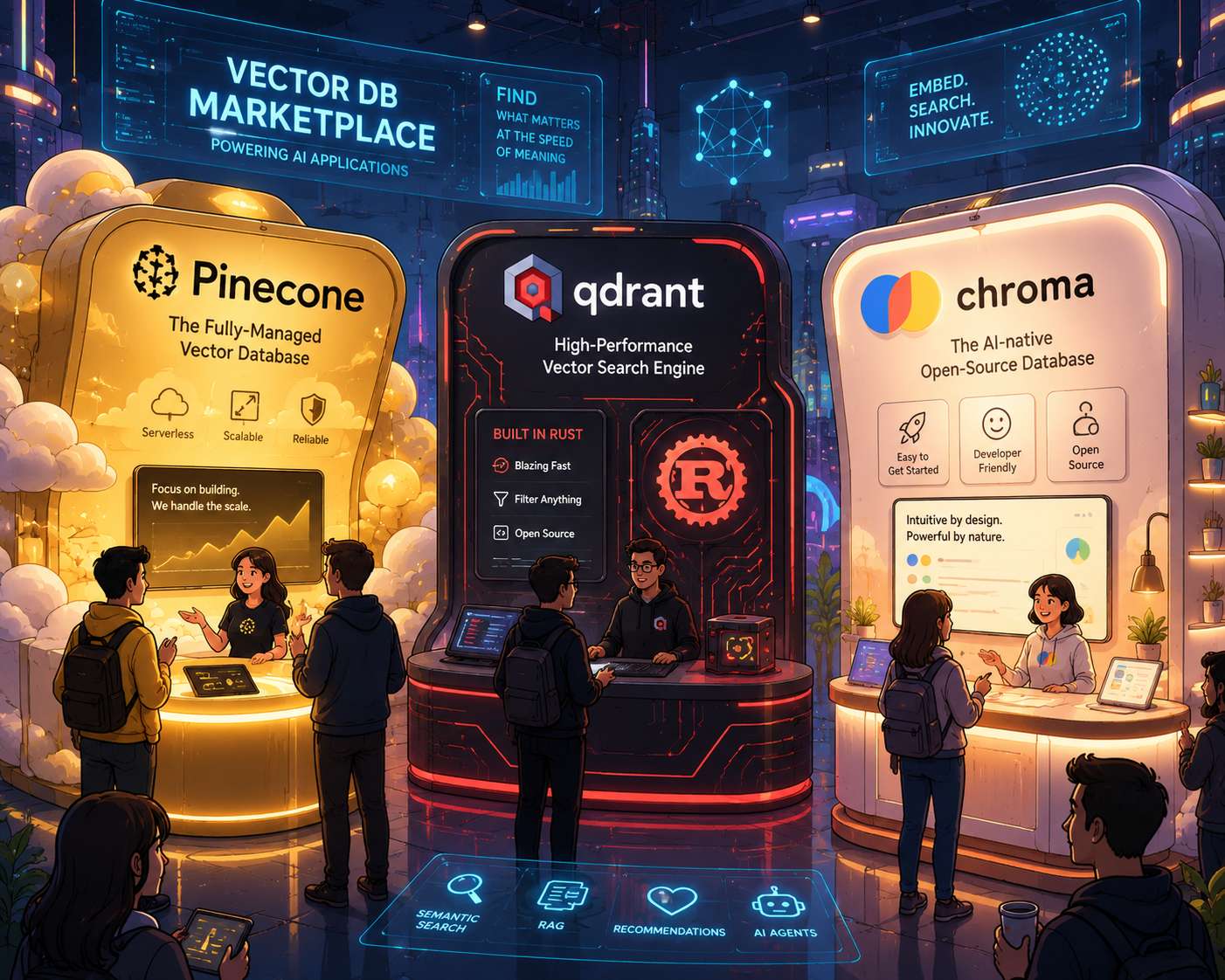
In the rapidly-evolving landscape of AI vector databases, several key players have emerged to simplify the complexities of operational management and make it easier for developers to build and scale their applications. Among these players, Pinecone stands out as a managed-cloud leader that effectively reduces operational complexity and scales well for production RAG systems. By providing a robust and scalable infrastructure, Pinecone empowers developers to focus on building cutting-edge applications without worrying about the underlying infrastructure.
Meanwhile, Qdrant has gained significant popularity among backend engineers due to its Rust-based architecture and impressive performance. Qdrant’s ability to deliver high-performance results has made it a go-to choice for many developers who require fast and efficient data processing. Its reliability and scalability have also made it an attractive option for large-scale applications.
Chroma, on the other hand, has become popular for its ease of use and simplicity, making it an ideal choice for minimum viable products (MVPs) and small AI tools. By providing a user-friendly interface, Chroma enables developers to quickly build and deploy their applications without requiring extensive technical expertise. This makes it an attractive option for developers who want to focus on building innovative applications rather than struggling with complex infrastructure.
As the AI vector databases market continues to grow, these key players are poised to play a significant role in shaping the future of this technology. With their innovative approaches and scalable infrastructures, Pinecone, Qdrant, and Chroma are empowering developers to build and deploy cutting-edge applications that can take advantage of the vast potential of AI vector databases.
Real-World Use Cases And Engineering Challenges
From powering AI copilots that help you find answers in company documentation to revolutionizing the way we search for code, ideas, and more, AI vector databases are the unsung heroes of the modern tech landscape. These powerful tools are transforming industries and redefining what it means to search and retrieve information.
In the world of software development, AI vector databases are used to enable semantic code search, recommendation engines, and even multimodal search. This means that developers can now find the exact piece of code they need in a fraction of the time, and recommendation engines can suggest the perfect library or tool for a specific task. The impact on productivity is staggering, and it’s no wonder that companies are clamoring to get in on the action.
But as with any new technology, there are challenges to overcome. Retrieval quality is a major hurdle when it comes to AI vector databases. Ensuring that the right information is surfaced at the right time is crucial, and it requires a deep understanding of how these systems work. Embedding drift and metadata filtering are also significant challenges, as they can easily throw off the delicate balance of the database.
And then there’s the matter of debugging. When things go wrong with an AI vector database, it’s not just a matter of tweaking a few settings – it requires expertise in AI infrastructure. This can be a barrier to entry for companies that don’t have the resources or know-how to tackle these complex issues. Nonetheless, the potential benefits of AI vector databases make them an exciting space to watch, and one that will undoubtedly continue to evolve and improve in the years to come.

Emerging Trends and Challenges
Hybrid retrieval is becoming increasingly popular, combining vector search with BM25 keyword search. This fusion of technologies is revolutionizing the way we approach information retrieval, enabling faster and more accurate results. By leveraging the strengths of both vector search and keyword search, hybrid retrieval systems can provide a more comprehensive understanding of user queries and deliver more relevant responses.
As the demand for AI vector databases continues to grow, the need for skilled professionals who can design and implement these systems is on the rise. Backend engineers are now in high demand, particularly those who have a deep understanding of embeddings and retrieval pipelines. These individuals are tasked with building and optimizing AI vector databases, ensuring that they can efficiently handle large volumes of data and deliver accurate results.
However, one of the biggest challenges facing the development of AI vector databases is security. While these systems offer many benefits, they also introduce new risks, particularly when it comes to malicious vectors. These vectors can be designed to poison RAG retrieval systems, compromising the integrity of the database and potentially leading to serious consequences.
To mitigate these risks, developers must prioritize security when building and deploying AI vector databases. This includes implementing robust safeguards against malicious vectors and ensuring that the database is designed with security in mind from the outset. By taking a proactive approach to security, developers can help to ensure that AI vector databases are both effective and secure, providing users with accurate and reliable results while also protecting against potential threats.

Can AI Vector Databases Catch Up Relational Databases?
As we wrap up our exploration of AI vector databases, it’s clear that these innovative solutions are revolutionizing the way we approach various applications. From image and speech recognition to natural language processing, AI vector databases are becoming an integral part of our technological landscape.
But what does the future hold for these cutting-edge solutions? The field is still evolving, and new challenges and trends are emerging. We’re seeing the rise of specialized AI vector databases designed for specific industries, such as healthcare and finance. These tailored solutions are helping to unlock new insights and drive business growth.
However, as AI vector databases continue to gain traction, it’s essential to understand their strengths and limitations. By recognizing the capabilities and constraints of these databases, developers can create more effective solutions that meet the needs of their users. This understanding will also enable businesses to make informed decisions about how to leverage AI vector databases to drive innovation and growth.
One of the key benefits of AI vector databases is their ability to handle large amounts of data with ease. This makes them an attractive option for applications that require fast and efficient data processing. Additionally, AI vector databases can be used for a wide range of tasks, from recommendation systems to anomaly detection. By leveraging the power of AI vector databases, businesses can unlock new revenue streams and gain a competitive edge in the market.
At the moment they are not as important as relational databases, but their significance is rising very quickly with modern AI software engineering.