Large language models have changed what software can do. Customer support assistants can answer questions around the clock, coding tools can generate entire functions, recommendation systems can personalize experiences, and writing assistants can produce useful content in seconds. A few years ago, many of these capabilities seemed unrealistic; today, they are becoming standard features in modern applications.
But there is an important catch: an LLM can produce an answer that sounds completely convincing while being wrong and the new big topic is how to prevent AI hallucinations in production.
This is what we commonly call a hallucination. The model may invent a fact, cite a nonexistent source, misunderstand retrieved information, call a tool incorrectly, or confidently answer a question when it simply does not have enough information. In a production application, that is more than an interesting limitation of AI. It is a reliability problem.
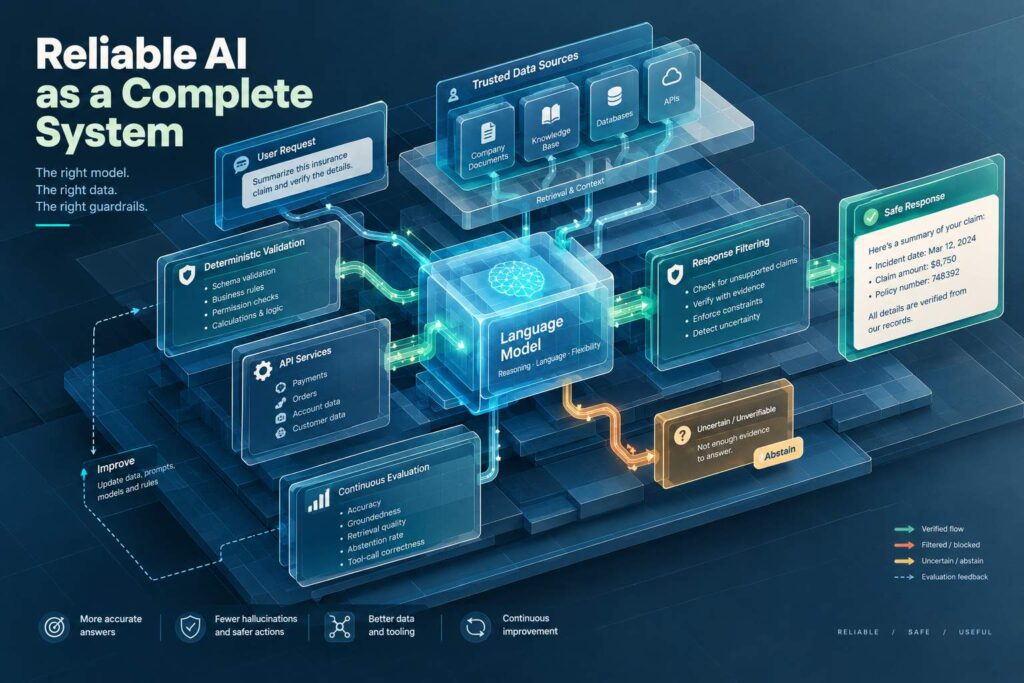
The good news is that hallucinations do not have to be accepted as an unavoidable part of building with LLMs. The most reliable systems use multiple layers of protection around the model rather than expecting the model itself to always behave correctly.
The key mindset shift is simple: don’t try to eliminate hallucinations with one perfect prompt; engineer the system so that incorrect answers are harder to produce, easier to detect, and less damaging when they occur.
That means grounding responses in trusted data, validating model outputs, allowing the model to abstain, evaluating the complete AI pipeline, and continuously learning from failures observed in production.

Not Every Failure Is a Hallucination
Before fixing hallucinations, it helps to understand what actually went wrong. Treating every incorrect response as the same problem often leads to ineffective solutions.
Consider a customer-support assistant that tells a user an incorrect refund policy. Several different things could have happened. The relevant policy might never have been retrieved. The correct document might have been retrieved, but the model could have misunderstood it. The information could have been outdated. The model might have invented a detail that was not present in the source. Or an external tool could have returned incorrect data.
These are different failure modes and require different solutions.
Retrieval failures happen when the system cannot find the right information. Improving document chunking, metadata, embeddings, search queries, or reranking may help here.
Unsupported claims occur when the model generates information that cannot be supported by the available evidence. Better grounding and verification are appropriate defenses.
Factual errors may require checking the answer against an authoritative database or deterministic business logic rather than another language model.
Instruction failures happen when the model does not follow the application’s requirements, such as returning invalid fields or ignoring constraints.
Finally, tool and agent failures can happen when an AI system calls the wrong tool, uses incorrect parameters, misinterprets its result, or takes an inappropriate action.
This classification matters because a better prompt will not fix a broken retrieval pipeline, and adding more documents will not necessarily fix faulty business logic.
Production AI should therefore be debugged like any other distributed system: identify the failing component first, then apply the appropriate engineering control.

Ground Answers in Trusted Evidence
One of the most effective ways to reduce hallucinations is to give the model access to information it should actually use.
Retrieval-augmented generation, or RAG, is a common approach. Instead of asking the model to rely entirely on information encoded during training, the application retrieves relevant documents and includes them as context when generating the response.
For example, imagine an internal IT assistant answering, “How do I reset my company laptop?” Rather than expecting the model to know the company’s current procedure, the system can retrieve the relevant internal documentation and ask the model to answer based on that material.
This approach is powerful, but RAG is not a magic anti-hallucination switch.
If retrieval returns irrelevant documents, the model is still working with bad information. If the knowledge base is outdated, the generated answer may faithfully reproduce outdated information. If the relevant information is missing entirely, the model may fill the gap using its own assumptions.
For production systems, the quality of retrieval therefore deserves as much attention as the quality of generation. Measure whether the correct documents are being retrieved, use metadata and filters where appropriate, and prefer authoritative sources for sensitive information.
Sometimes RAG is not even the best solution. For current prices, account balances, order status, permissions, or other structured facts, calling an authoritative API or database is usually safer than asking a model to generate the answer from documents.
A useful rule is: use the model for language and reasoning, but let authoritative systems remain the source of truth for facts that matter.

Let the Model Say “I Don’t Know” and Prevent AI Hallucinations in Production
A surprisingly important production capability is allowing the model to refuse to answer.
Many AI applications implicitly encourage hallucinations by requiring an answer to every question. If the system provides no reliable evidence but still expects a confident response, the model has an incentive to produce something plausible.
Instead, design the application around abstention.
Suppose a legal-document assistant receives a question about a policy that does not exist in its knowledge base. A safer response is:
“I don’t have enough information in the available documents to answer that.”
That may look less impressive than a detailed answer, but from a reliability perspective it can be far more valuable.
Abstention can also be enforced systematically. The application can require a minimum retrieval score, require citations for factual claims, or send uncertain responses through an additional verification step. If the necessary evidence is missing, the backend can prevent the response from being presented as authoritative.
This is especially important in high-risk applications where a wrong answer is significantly worse than no answer.
The goal is not necessarily to maximize the percentage of questions answered. The better goal is to maximize correctly answered questions while minimizing confidently incorrect ones.
This introduces an important production trade-off. A system that answers everything may have impressive coverage but poor reliability. A system that refuses everything is safe but useless. Good AI engineering finds the appropriate operating point for the application’s risk tolerance.
Abstention should therefore be treated as a legitimate outcome and measured alongside accuracy. Track how frequently the system refuses, why it refuses, and whether those refusals were actually appropriate.

Verify Before You Trust
For low-risk applications, generating a response directly from grounded context may be sufficient. For high-value operations, however, trusting a single generation step is often not enough.
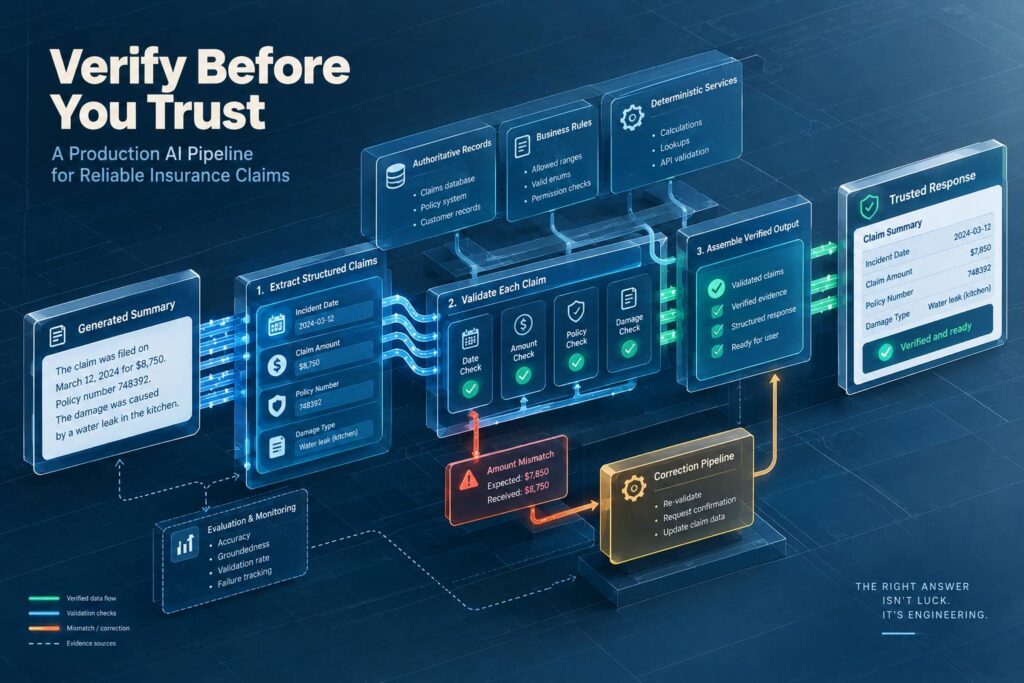
A stronger architecture separates generation from verification.
Imagine an AI assistant that summarizes an insurance claim. Instead of simply checking whether the overall summary “sounds correct,” the system can extract individual claims such as the incident date, claim amount, policy number, and reported damage. Each claim can then be checked against the original records.
The same principle works for many applications. A coding assistant can have generated code checked by a compiler and automated tests. A financial application can validate calculations against deterministic code. A customer-support system can verify policy statements against its source documents.
This is powerful because traditional software is exceptionally good at checking things that language models are not. A backend service can determine whether a number is within an allowed range, whether an enum value is valid, whether a user has permission to perform an action, or whether a calculation matches the expected result.
Structured outputs make this approach easier. Instead of asking a model to return an arbitrary block of text, require a defined schema with fields, types, and allowed values. The backend can then validate the response before it reaches the user or triggers an action.
For particularly important claims, a separate verification model can also evaluate whether the generated statement is supported by the supplied evidence. But model-based verification should complement deterministic checks, not replace them.
The broader principle is straightforward: never give a probabilistic system responsibility for a constraint that ordinary software can enforce reliably.
Evaluate, Trace, and Improve Continuously
A production AI system is never finished. Models change, prompts evolve, retrieval indexes are rebuilt, documents become outdated, and user behavior introduces unexpected edge cases.
That makes continuous evaluation essential.
Start with a representative evaluation dataset containing real user questions, difficult examples, known hallucinations, and adversarial cases. Run this dataset whenever you change the model, prompt, retrieval system, or surrounding application.
Do not rely on a single “accuracy” number. Track metrics that correspond to the actual failure modes of your system: answer correctness, groundedness, retrieval quality, abstention rate, tool-call correctness, and regression rate.
Observability is equally important. When an incorrect answer appears in production, engineers need to reconstruct what happened. A useful trace should capture the model and prompt version, user input, retrieved documents, tool calls, relevant intermediate steps, final output, and available user feedback.
Without this information, debugging becomes guesswork. With it, an engineer can determine whether the problem came from retrieval, generation, a tool, stale data, or an application-level validation failure.
Most importantly, production failures should become future tests. When a customer discovers a hallucination, add that example to the evaluation set. The next model or prompt version should prove that the same failure has not returned.
Over time, this creates a feedback loop: observe failures, understand their causes, turn them into tests, improve the system, and continuously measure the result.
That is how hallucination prevention becomes an engineering discipline rather than a collection of prompt tricks.

Conclusion: Engineer for Reliable AI
Hallucinations are one of the most visible weaknesses of modern LLM applications, but they are not simply a problem that developers have to accept.
The most reliable approach is to treat an AI feature as a complete software system. First, identify what kind of failure occurred. Then ground the model in authoritative information, retrieve carefully, and use APIs or databases whenever they are a better source of truth.
Give the model permission to say that it does not know. Validate structured outputs before using them. Verify important claims against evidence and use deterministic business rules wherever possible. Most importantly, continuously evaluate the system using realistic production examples rather than assuming that a model that worked during development will remain reliable forever.
There is also an important lesson in all of this: the model should not be the only component responsible for correctness.
Modern AI systems work best when probabilistic models are surrounded by deterministic engineering. The model handles language, interpretation, and flexible reasoning, while retrieval systems provide evidence, APIs provide authoritative facts, validators enforce constraints, and evaluation systems measure whether everything works as expected.
You probably cannot guarantee that an LLM will never hallucinate. You can, however, build a production system where hallucinations are less frequent, easier to detect, prevented from triggering dangerous actions, and continuously turned into opportunities for improvement.
That is the practical path from an impressive AI demo to a reliable AI product.