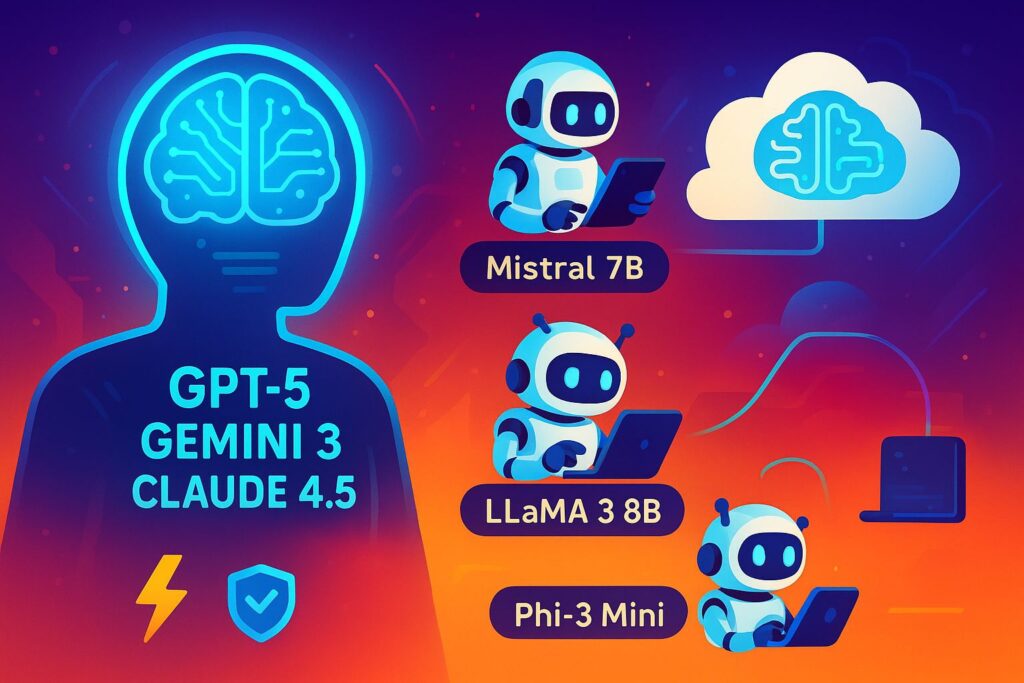
In recent years, large language models like GPT-5, Google’s Gemini 3 Pro/Flash, and Anthropic’s Claude 4.5 Opus have dominated headlines with cutting-edge performance. But there’s also a quieter revolution underway – smaller LLMs are delivering strong performance on many real-world tasks while drastically reducing costs and enabling on-device AI.
Models such as Mistral 7B, LLaMA 3 8B or Phi-3 Mini demonstrate that you don’t always need massive parameter counts to get useful results – especially when efficiency, privacy, or offline capability matters. At ArtifiByte, we use Mistral 7B in Content Pilot, proving that smaller LLMs are capable of completing many common tasks without the need for bigger models.
Smaller models matter because they reduce inference cost, latency and power. They make AI accessible to developers and teams without massive infrastructure. Even modest hardware can run them without the need to access LLMs online.
They allow on-device and privacy-sensitive applications. And finally, they provide developers with better fitted options instead of using expensive and complex LLMs for tasks that don’t need them in the first place.
In this post, we’ll explore why smaller models are gaining traction, how hybrid cloud-edge patterns work, what tradeoffs to expect and where the technology is headed next.
Why Smaller Models Matter
In today’s era of rapid technological advancements, smaller AI models are gaining significant attention. But why do they matter? What benefits do they bring to the table, and how can they revolutionize the way we use artificial intelligence?
While most people associate AI with massive models available online via chat interface, small language models are quietly breaking that pattern. Thanks to advances in model design, compact LLMs can deliver similar performance on everyday tasks.
One of the primary reasons smaller models matter is that they significantly reduce inference cost, latency and power consumption. When models are smaller, they require less computational resources to process information, resulting in faster performance and lower energy consumption.
This not only makes them more efficient but also more environmentally friendly. By trimming down the size of AI models, developers can create applications that consume fewer resources, making them more accessible without excessive power needs.
Another significant advantage of smaller models is that they enable on-device privacy-sensitive apps and low-cost hosting. When models are hosted on-device, users have more control over their data and security – it is a big win for privacy, regulatory compliance (GDPR) and offline access.
Smaller models also require less infrastructure, resulting in cost savings for developers and businesses. Instead of relying on expensive GPU clusters, developers can deploy smaller models on existing hardware.
This reduced infrastructure need promotes accessibility, making it easier for devs to deploy applications without enormous costs that large LLMs bring.
By minimizing the computational resources applications are more affordable and easier to deploy. This opens up new opportunities to create innovative use cases that were previously too cost-prohibitive.
With the rise of smaller models, we can expect to see a significant shift in the way AI is developed and deployed, making it more accessible, efficient and sustainable for everyone.

Hybrid Cloud-Edge Patterns
In the age of AI and ML, data is being generated at an unprecedented rate, and with it, the need for efficient and scalable solutions. One approach that is gaining traction is Hybrid Cloud-Edge Patterns, a strategy that balances cost and performance.
Use small local models for privacy and latency
When it comes to narrow and well defined problems, local models come into play. These models are designed to be small, quick, and efficient, making them perfect for edge computing.
By processing data locally, you can ensure that sensitive information remains on-device, reducing the risk of data breaches and ensuring user privacy. Moreover, local models can handle tasks that require low latency, providing a seamless user experience.
Call larger cloud models for heavy reasoning or fallbacks
However, there are times when local models just won’t cut it. That’s where the well known LLMs come in – larger, more powerful and capable of handling complex tasks.
By leveraging cloud models, you can offload heavy reasoning and complex solutions, task that are too heavy for small models at the moment. Additionally, big cloud models can serve as a fallback option when local models are unable to provide an accurate result, ensuring that users receive the best possible experience.
The beauty of Hybrid Cloud-Edge Patterns lies in its ability to balance cost, performance and user experience. By using small local models for light tasks and calling larger cloud models for heavy reasoning, the solution is optimized for maximum efficiency.

Cost vs. Performance Tradeoffs
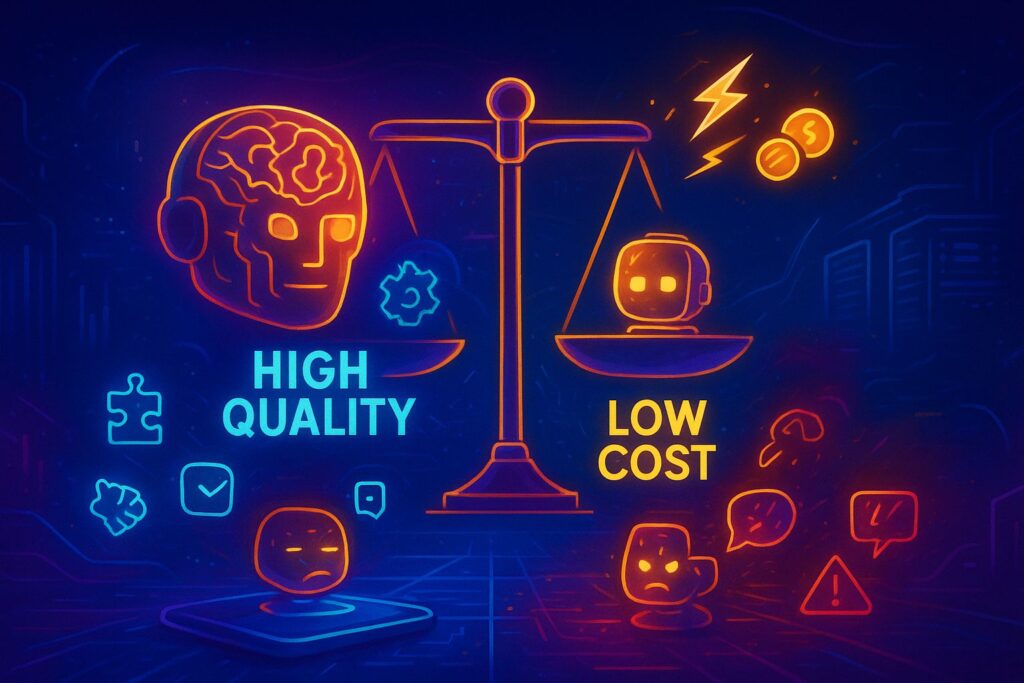
When scaling down LLM size, developers face a balancing act between efficiency and quality. Two key factors that often come into play are model size and quality. But what happens when you try to reduce one without sacrificing the other?
It turns out that a 2-4 fold reduction in model size can result in only small drops in quality on many common tasks.
This is a significant finding, especially for industries where computational resources are limited or expensive. By using smaller LLM where it makes sense, companies can potentially save on GPU resources, reduce latency and even improve deployment times.
However when the compression is too extreme and we try to squeeze to many weights out of the model, it can have bad consequences.
Visible errors start to creep in, especially on the corner cases, nuanced reasoning, or uncommon inputs. The impact can be subtle, but it’s there nonetheless. Users may notice more frequent errors in the model’s responses, or they might begin to question its accuracy.
And there’s another potential problem as the model size reduction can also have an unintended side effect: it can amplify existing biases or degrade behavior.
Think of it like trying to squeeze a square peg into a round hole – you might end up with a model that works okay, but not optimally. This is because the compression process can introduce new patterns or relationships that the model wasn’t originally designed to handle.
To mitigate these risks, it’s essential to carefully evaluate the tradeoffs between cost and performance. By doing so, we can make informed decisions about how to balance model size and quality, and ensure that your AI systems deliver the best possible results for your users.
The key is understanding where performance matters most and choosing a model size that fits the specific use case, whether it’s real-time command handling or high-stakes decision support.
Further Challenges for Small Models
Despite gains, smaller LLMs face some common limitations. One of the most notable difficulties is open-ended creative generation.
Tasks that demand broad creativity – like narrative storytelling or highly imaginative generation – still tend to favor very large models, which have seen more diverse training signals.
Small models are designed to produce specific, task-oriented responses. When it comes to more complex tasks in writing, art or music, the requirement for imagination and originality can be a significant hurdle.
Smaller models may struggle to generate novel and engaging content, often relying on what they’ve learned from their training data rather than creating something truly new.
Another challenge is achieving extremely long-context reasoning without retrieval. While smaller LLMs can handle relatively short contexts, they often struggle when faced with longer, more complex inputs. This is because their architecture is limited by their size, making it difficult to process and understand the nuances of a large context.
Smaller models also may struggle with rare or edge inputs. When faced with a word or phrase that is not in so common, they may struggle to understand its meaning or generate a coherent response. This can lead to inaccurate or irrelevant outputs, particularly when dealing with specialized or technical domains.
Even though small language models face significant challenges in complex tasks, long-context reasoning and handling rare or edge inputs, they still have their place in current AI scope.
And while they have made significant strides in recent years, there is still much work to be done to develop models that can truly match the capabilities of their larger counterparts.

Conclusion and Future Directions
The journey of AI model development has been a wild ride recently, with numerous breakthroughs and innovations along the way.
As we reflect on the progress made, it’s clear that the future of AI model development will be shaped by large companies their famous big capable LLMs.
But if the smaller LLMs prove their advantages, the future can be hybrid: powerful models in the cloud and smaller models on devices.
Complex tasks can be tackled in the hybrid approach more efficiently, not needing significant computational resources. By leveraging the strengths of both big and small LLMs, we can unlock a new level of AI-driven innovation.
Smaller models won’t replace large LLMs – instead, they can complement them. The ability to deploy AI models on devices can revolutionize the way we interact with technology.
What do you think about the trajectory of AI models – will hybrid AI become the norm? Let us know in the comments!