Harness engineering is a rapidly evolving discipline that focuses on creating AI agents that can design their environment and tools. This emerging field is transforming the way we approach software development, with significant implications for various industries.
At its core, harness engineering involves the development of AI agents that can modify and adapt their surroundings to optimize their performance and efficiency. This requires a deep understanding of the system’s dynamics and how different components interact with each other.
The surrounding system plays a crucial role in engineering outcomes, as AI agents rely on their environment to operate effectively. This interdependence highlights the importance of designing AI systems that are not only intelligent but also adaptable and resilient.
What is harness engineering, and how does it differ from traditional software development? Harness engineering emphasizes the need for a more holistic approach, where AI agents and their environment are designed together. This integrated approach enables the creation of more sophisticated and autonomous systems that can evolve over time.
Harness engineering is a promising field that holds great potential for innovation and growth. As it continues to mature, we can expect to see new breakthroughs in various areas, from AI development to software engineering.

Why Harness Engineering Matters
Harness engineering is a crucial aspect of agent-first development. Designing environments and feedback loops is essential for reliable performance. However, simply improving prompts is not enough to guarantee consistent results.
Effective agent-first development requires a deeper understanding of how to create environments that work in tandem with the agent’s code. This involves designing systems that can adapt to the agent’s actions and provide meaningful feedback. By doing so, developers can create agents that learn and improve over time, rather than just generating random or incorrect responses.
Building reliable agents is a complex task that requires careful consideration of the entire system. A single line of agent-generated code can have a significant impact on the overall performance of the agent, which is why having a robust harness is essential. With millions of lines of code involved, even small errors can have far-reaching consequences.
A reliable harness is not just a necessary tool, but an integral part of the development process. By focusing on harness engineering, developers can create agents that are more accurate, efficient, and effective.

Context Engineering for AI Agents
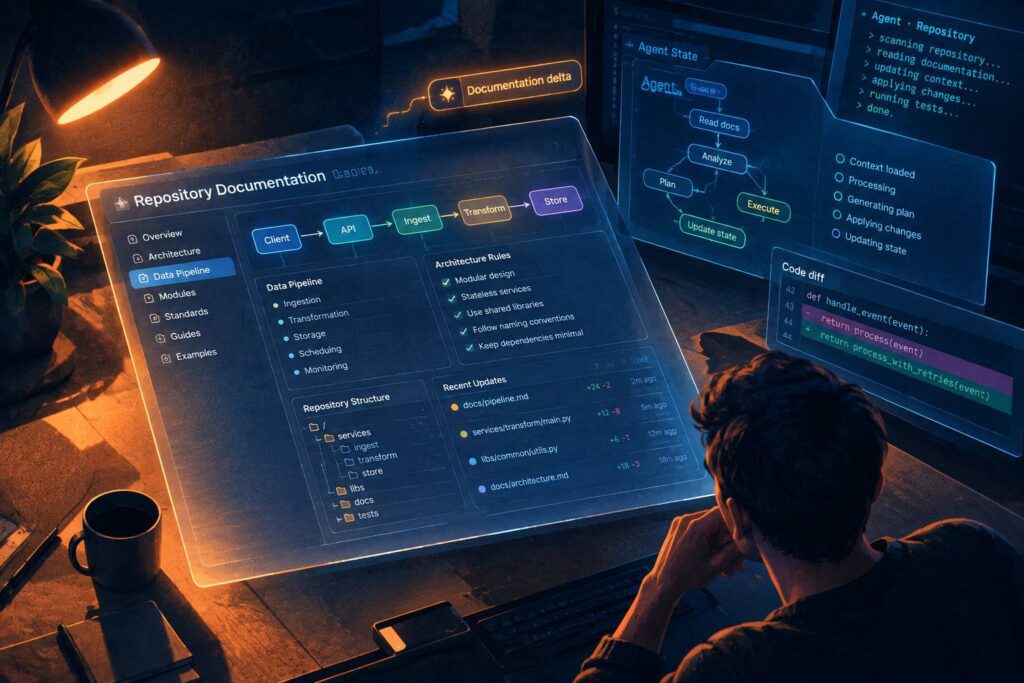
Repository documentation serves as an engineered input, a blueprint for the successful operation of an AI agent. Architecture rules, conventions, tests, and persistent agent state all play crucial roles in determining effectiveness.
When it comes to an AI agent’s performance, the quality of the context it can retrieve and maintain is a significant factor. An agent that can effectively retrieve relevant information and adapt to its environment is far more likely to achieve its goals than one that struggles with context.
Repository documentation provides a critical foundation for context engineering, establishing the framework for how an agent will interact with its environment. Architecture rules, for instance, dictate how the agent will structure its knowledge base, while conventions ensure that the agent can communicate effectively with other systems.
Tests and persistent agent state are also crucial components of context engineering, as they enable the agent to learn from its experiences and adapt to changing circumstances. By considering these factors, developers can create AI agents that are more effective, more reliable, and more capable of achieving their goals.
Long-Running Agents and Harnesses
The modern harness is a crucial component of harness engineering, which involves structured progress artifacts and incremental tasks. This allows for a more organized and efficient approach to continuous work. Harnesses are designed to adapt to new context windows, making it easier to pick up where you left off, even in different environments.
Initialization steps are essential for continued work in new context windows. They provide a clear starting point and ensure that ongoing tasks are properly set up. This is particularly important in harness engineering, where the goal is to create a seamless experience for users. By focusing on initialization, you can ensure that your harness is set up to handle new context windows with ease.
One of the key benefits of harness engineering is that it does not rely on previous model memory. This means that each new task or context window can be approached independently, without the need to reference prior work. This allows for greater flexibility and adaptability, making harness engineering an attractive solution for complex projects.
Harness engineering is the backbone of what is harness engineering, and understanding its principles is crucial for creating effective harnesses. By breaking down the process into smaller, incremental tasks, you can build a harness that is robust, efficient, and easy to use.

Verification and Feedback Loops for AI Agents
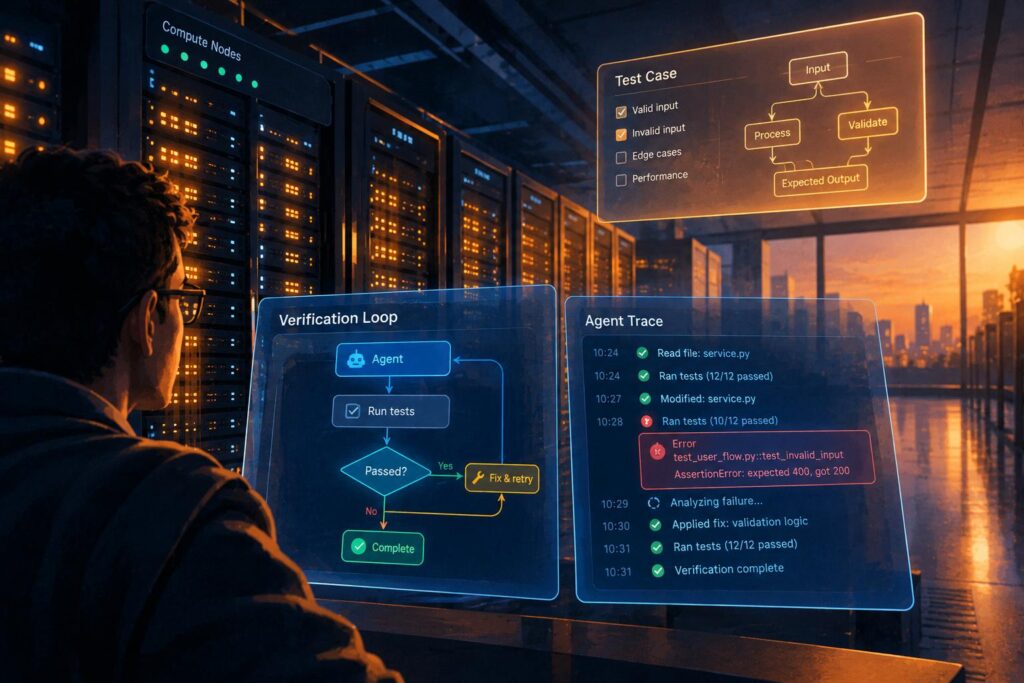
Tests, linters, type checking, and runtime checks are all crucial components for ensuring the reliability of AI agents. These tools help developers identify potential issues before they become major problems, but their limitations become apparent when the agent is deployed in the real world. Model-based confidence, which relies on the agent’s internal state to gauge its own performance, is no substitute for the kind of actionable feedback that can only come from executing code in a real environment.
To truly reliable and trustworthy, AI agents need to be able to detect and correct their own failures. This is where executable feedback loops come in – a process that involves running the agent’s code in a controlled environment and gathering feedback on its performance. By replacing model-based confidence with executable feedback loops, developers can gain a deeper understanding of their agent’s strengths and weaknesses, and make targeted improvements to its performance.
Executable feedback loops also enable agents to learn from their mistakes, adapting to new situations and improving their overall reliability over time. This means that AI agents can become increasingly capable and trustworthy, even in complex and dynamic environments. As developers, our job is to create the conditions for this process to occur, by building in the tools and mechanisms that allow the agent to learn from its mistakes and improve its performance.
Harness Engineering for the Enterprise
Enterprise harnesses are harnessing the power of governance to bridge the gap between identity, permissions, policies, and observability. They’re becoming the go-to solution for organizations seeking a unified approach to managing their infrastructure.
By combining identity, permissions, policies, and observability, enterprise harnesses provide a comprehensive governance layer that helps organizations stay in control. But that’s not all – audit trails and model/tool abstraction are also crucial components that enable organizations to track changes and streamline their workflows.
The beauty of enterprise harnesses lies in their ability to abstract away complex infrastructure, making it easier for organizations to manage their resources. This abstraction also enables more efficient model development, deployment, and monitoring. With enterprise harnesses, organizations can focus on building and deploying applications, rather than getting bogged down in the intricacies of infrastructure management.

The Key Design Question
The key design question for backend engineers is no longer about crafting the perfect prompts. Gone are the days of tweaking every detail to coax the desired response from AI agents. Instead, the focus has shifted to designing the environment, capabilities, and feedback system that enables these agents to perform at their best.
This comprehensive approach to design requires considering the intricacies of how AI agents interact with their surroundings. It involves creating a harmonious balance between the agent’s abilities, the data it receives, and the consequences of its actions. This delicate balance is crucial for building reliable AI agents that can adapt to new situations and learn from their mistakes.
Reliability in AI agents is not a binary concept. It’s not a matter of simply choosing the right tools or techniques. Rather, it’s a multifaceted challenge that demands a thoughtful and systematic approach. By designing the right environment, capabilities, and feedback system, engineers can create AI agents that are resilient, consistent, and able to perform their intended tasks with accuracy.
The stakes are high, and the consequences of failure can be severe. Whether it’s a chatbot that provides incorrect information or a recommendation engine that makes ill-advised suggestions, the impact of unreliable AI agents can be far-reaching. As such, backend engineers must prioritize design and focus on creating a robust and reliable foundation for their AI agents.