When it comes to tackling complex problems, AI models can hit a wall. They excel at simple language and data tasks, but their accuracy plummets as the challenge increases, particularly when it comes to deep scientific reasoning.
This phenomenon has significant implications for various industries and fields that rely heavily on AI-driven insights.
Benchmarking studies shed light on the limitations of top AI models, including Google’s Gemini. Despite its advanced capabilities, Gemini achieved only about 69% factual accuracy.
This is concerning, especially when considering the multifaceted nature of real-world queries. As AI models grapple with complex tasks, their inability to provide accurate and reliable responses becomes increasingly apparent.
The consequences of AI inaccuracy are far-reaching, and there are many industries reaching the current limits of LLM capabilities. AI assistants are frequently deployed to generate news content, but the results are often marred by errors and inaccuracies.
In some cases, a significant proportion of responses can contain factual inaccuracies. This highlights the challenges of factual grounding under complexity, which is a critical aspect of AI accuracy vs task complexity.
The disparity between AI’s performance on simple tasks and its struggles with complex ones underscores the need for more robust and sophisticated AI models. To bridge this gap, researchers and developers must focus on creating AI systems that can effectively handle complex queries and provide accurate, reliable responses.
Only by addressing the challenges of AI accuracy vs task complexity can we unlock the full potential of AI and harness its power to drive meaningful progress in various fields.
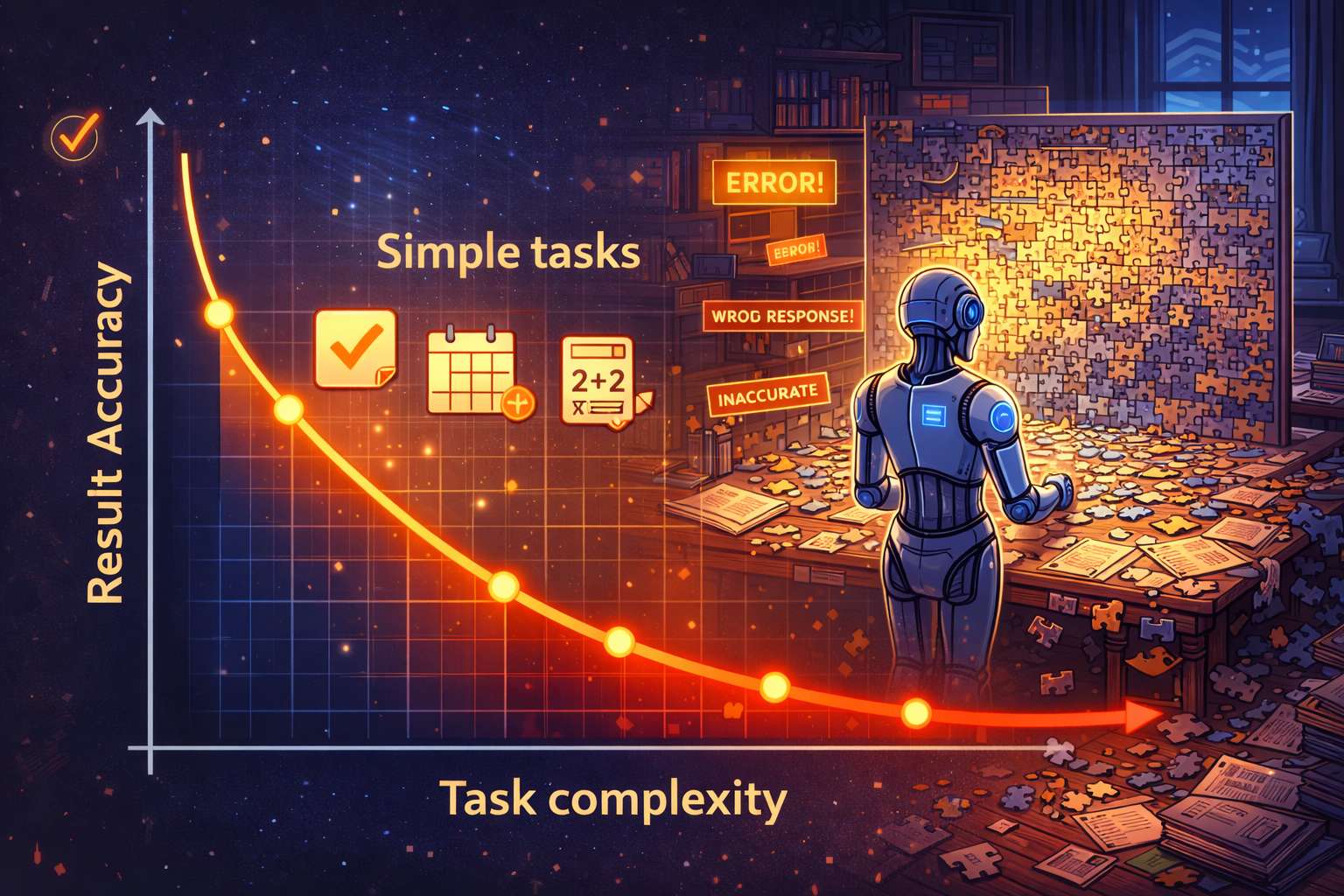
AI Accuracy vs Task Complexity Battle
Leading AI models experience “accuracy collapse” when confronted with highly complex reasoning tasks beyond benchmark thresholds. These tasks often push the limits of what AI models can handle, and the results are insufficient. Despite being trained on vast amounts of data, AI models can struggle to work effectively when faced with nuanced and multi-faceted problems.
Research shows that AI can mimic plausible answers without genuine understanding, leading to the trust paradox, where believable responses may still be incorrect. This phenomenon occurs when AI models are able to generate responses that sound intelligent and authoritative, but lack the underlying knowledge and reasoning to support them. As a result, users may find themselves trusting AI without critically evaluating their accuracy.
The relationship between AI accuracy and task complexity is a hard one. Model performance degrades with complexity of given tasks and context loss, meaning models struggle more on multi-step problems requiring global understanding.
In essence, the more complex the task, the more AI models tend to falter. This is because complex tasks often require a level understanding that is beyond current technology limits and relationships between different pieces of information, which AI models may not be equipped to handle.
The AI accuracy vs task complexity challenge has significant implications for the development and deployment of AI systems. As AI continues to play a larger role in our lives, it’s essential that we understand the limitations of these systems and design them to handle the complexities of real-world tasks.
By acknowledging the challenges posed by this tradeoff, we can work towards creating more robust and reliable AI systems that can tackle even the most daunting challenges.

Training Data Limitations
When it comes to multimodal AI, a fascinating yet concerning trend has emerged. Studies show that the performance of these intelligent systems often correlates more with the abundance of training data than any genuine scientific understanding of the subject.
This has a direct impact on accuracy, particularly when dealing with less-represented and complex cases. The more data an AI model is trained on, the better it can perform within its comfort zone. However, when faced with unfamiliar or rare scenarios, its accuracy falters significantly.
The relationship between AI performance vs task complexity is especially noteworthy. As tasks become increasingly intricate and demanding, human behavior and adoption strategies are influenced in profound ways.
A higher cognitive load can trigger avoidance, leading to suboptimal results or even errors. The stakes are high, and the challenge is clear: can we design AI systems that excel in a wide range of situations, without compromising on efficiency or accuracy?
Some approaches suggest that matching model complexity to task properties is crucial, as overly complex systems can add significant costs without yielding proportional accuracy gains. This delicate balance is essential in various domains, from healthcare to finance, where the margin for error is nonexistent.
The stakes are high, and the debate is ongoing. Can we strike a balance between AI accuracy vs task complexity? By acknowledging the limitations of training data and designing AI systems that can adapt to varied scenarios, we can unlock true potential and harness the full power of multimodal AI. The journey ahead is complex, but the rewards are undeniable.

Human-AI Collaboration
When we think of AI, we often imagine a future where machines can perform tasks with unparalleled speed and accuracy. But what happens when we bring humans back into the equation?
A growing body of research suggests that while AI tools can indeed speed up simple workflows, they may trade off accuracy when used without humans on nuanced tasks.
This trade-off becomes more apparent when we examine the intersection of AI accuracy and the complexity of tasks. In essence, AI accuracy vs task complexity issues can arise when we push AI tools to perform tasks that require human intuition, creativity and critical thinking.
While AI can excel in tasks that involve pattern recognition and data analysis, it often struggles with tasks that involve ambiguity and uncertainty.
The human-AI collaboration dynamic can temorarily resolve this issue, as humans and AI systems can achieve better results as of today. When humans and AI work together, accurate decision-making relies on effective information exchange, which cannot be achieved by machines alone.
One of the key benefits in human-AI collaboration is the supervision of humans to correct AI errors and provide context to AI systems that struggle to understand complex situations. This can lead to much better AI performance for highly complex tasks as humans are step in to intervene to prevent errors from occurring.
By acknowledging these trade-offs, we can begin to design more effective human-AI collaboration systems that leverage the strengths of both humans and AI to achieve better outcomes. Ultimately, the key to successful human-AI collaboration lies in finding a balance between speed, accuracy and complexity.

Suggestions for Better Results
In order to get the best results today, there are several simple steps that can help with achieving better results. Eventually, AI systems will not need these tips as they will become much better, but now it is necessary to use a few guides that improve the outputs.
The most helpful improvement is breaking down big questions into smaller, clear queries when prompting can make a significant difference in the outcome. It’s like giving a chef a detailed recipe instead of just asking for a meal. This approach allows the AI to focus on one aspect at a time, leading to more accurate and relevant responses.
Another crucial step is cross-checking key facts with another LLM or a trusted source. This simple yet effective technique can help reduce frequent errors and ensure that the generated information is accurate and up-to-date. Think of it as having a team of experts reviewing each other’s work to ensure quality.
When working on nuanced topics, it’s essential to remember that AI is best used as a draft or assistant, not the final decision-maker. By treating AI as a collaborative tool, you can leverage its strengths while maintaining control over the final outcome. This approach ensures that the accuracy and context are maintained, especially when dealing with complex topics.
The relationship between AI accuracy vs task complexity is a complicated one. As tasks become more specialized and intricate, accuracy can drastically differ. However, by providing relevant examples, references or background information, you can significantly improve outputs on these topics. This is because AI can learn from the context and make more informed decisions.
Ultimately, getting the most out of AI requires a combination of clear prompts, cross-validation and a willingness to use AI as a tool rather than a sole authority. By adopting these strategies, you can unlock the full potential of various models and achieve better results in your projects and tasks.
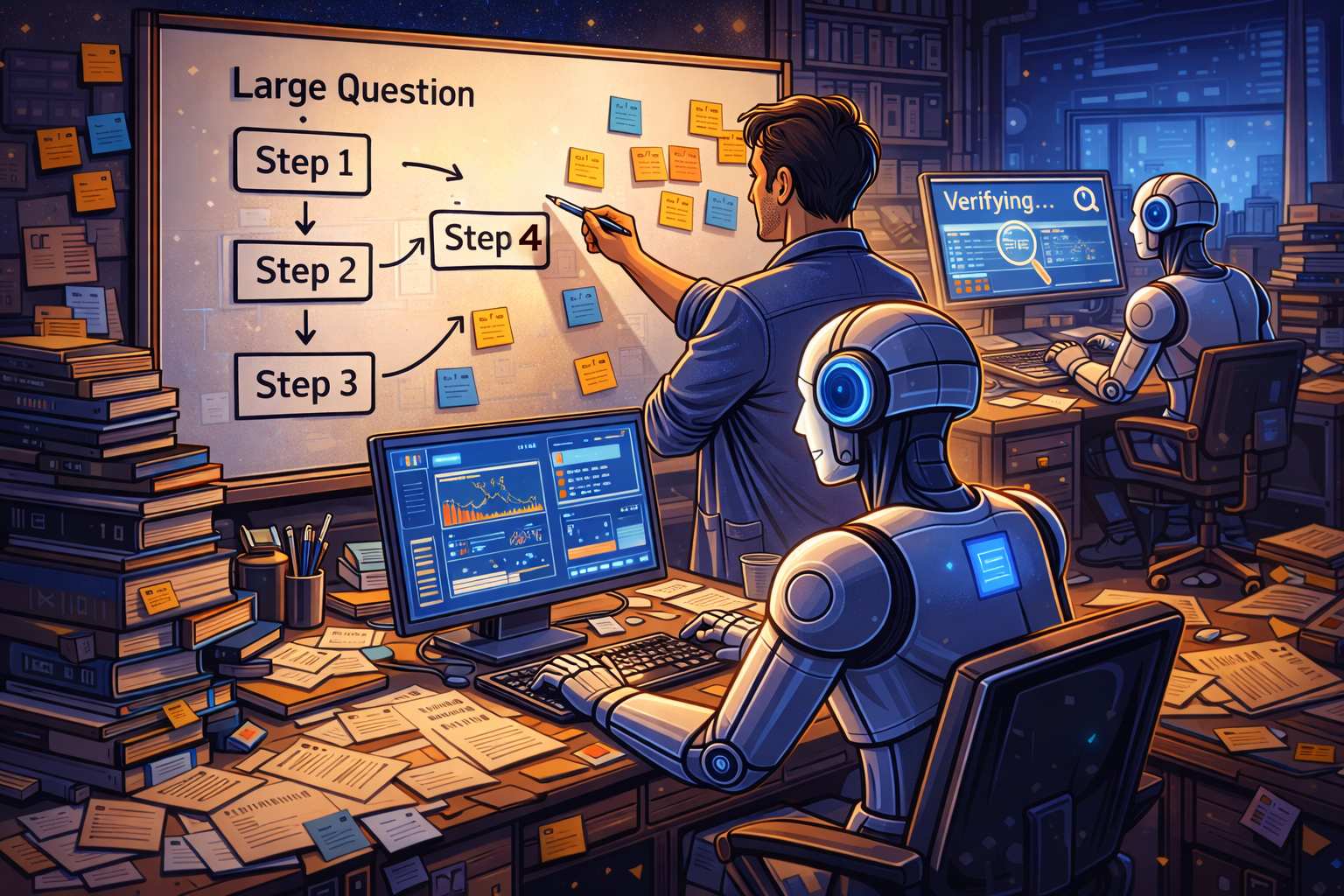
Getting Better Results from AI, Even on Hard Tasks
While AI has made tremendous strides in recent years, its ability to produce accurate results declines significantly as the complexity of the task increases. This is particularly evident in nuanced or multi-step problems, where even the most confident answers can be wrong.
So, what’s causing this decline in AI accuracy vs task complexity? One major culprit is context loss, which occurs when AI models fail to fully understand the nuances of a particular context or scenario. This can lead to shallow reasoning and a lack of depth in the model’s decision-making process.
Overconfidence is another common issue, particularly when it comes to complex tasks. AI models can become so convinced of their own correctness that they fail to consider alternative perspectives or possibilities. This can result in inaccurate or incomplete answers that are presented with unwarranted confidence.
But here’s the good news: there are practical strategies that we discussed today that can help improve AI results, even on hard tasks. By breaking down complex tasks into manageable steps, asking AI models to provide explanations for their answers and restating goals in clear and concise language, users can significantly improve the quality of the output.
The key takeaway is that better AI results come not from more powerful models alone, but from clear prompts, realistic expectations and active user guidance. By working together with AI models and providing them with the right tools and context, we can unlock their full potential and achieve more accurate and reliable results, even on the most complex tasks.
What is your experience with complex task? Does current AI handle it well? Let us know in the comment section!