Currently, we are in a world where the cost of running artificial intelligence systems plummeted at an unprecedented rate, making it possible to deploy AI-powered solutions on a massive scale.
Just a few years ago, running large scale AI was costly and cumbersome, but with the rise of generative AI, everything changed.
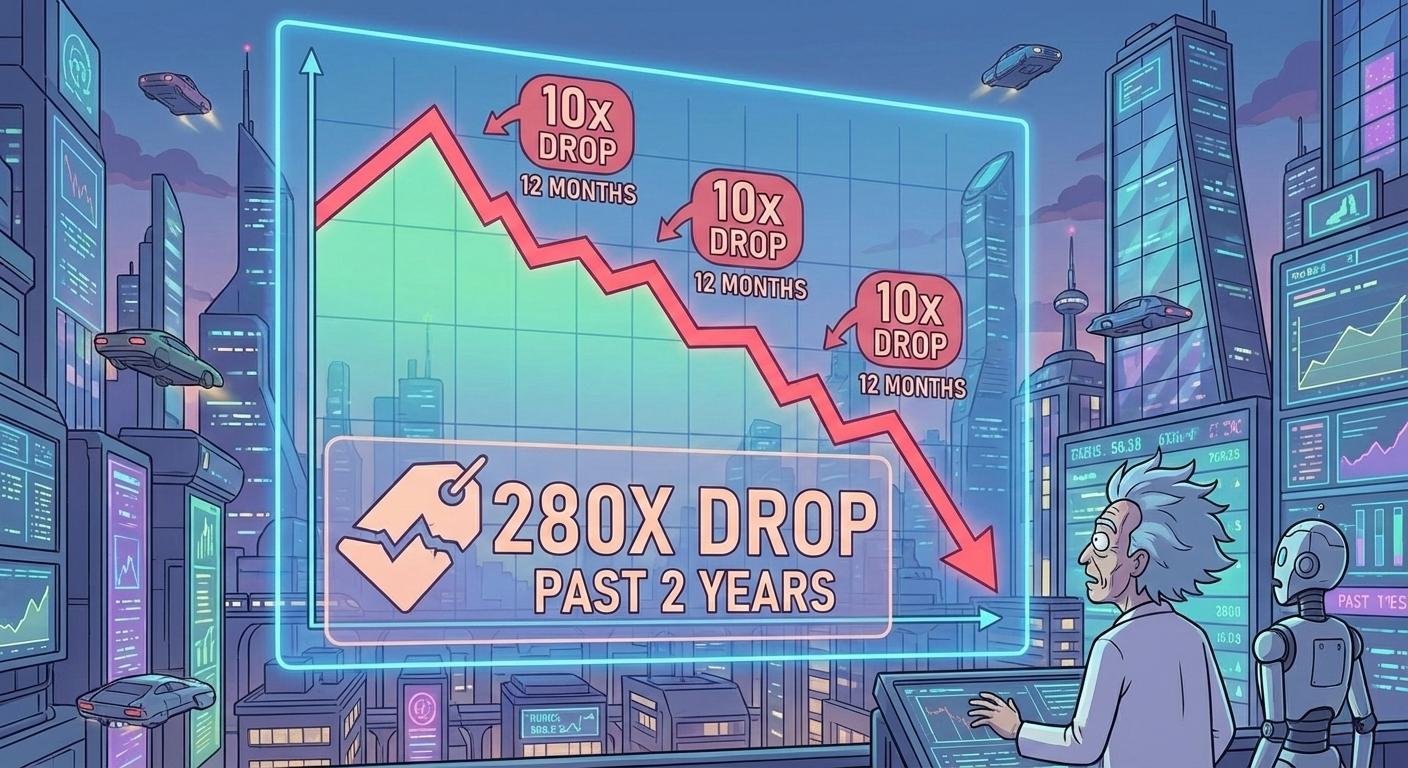
We’re now living in a reality, where the cost to run a given level of AI inference has fallen roughly 10× every 12 months, a rate of decline that far outpaces traditional Moore’s Law.
This remarkable trend has been unfolding over the past few years, with the past 18-24 months seeing LLM query prices drop by an astonishing 280×. To put this into perspective, this means that what would have cost a substantial amount of money just a couple of years ago can now be achieved at a fraction of the cost. The implications are far-reaching and exciting.
As AI continues to evolve and improve, we’re witnessing an exponential decrease in its operating costs.
This phenomenon is often referred to as the ‘AI cost reduction,’ and it’s having a significant impact on various industries. From healthcare and finance to education and customer service, businesses are harnessing the power of AI to drive innovation, improve efficiency and enhance customer experiences.
The rapid pace of AI cost reduction is making it possible for organizations to explore new use cases and applications that were previously out of reach due to budget constraints.
It’s also enabling the development of more sophisticated AI models, which can tackle complex problems and provide better outcomes.
As we look to the future, it’s clear that the AI cost reduction trend will continue to accelerate, opening up new opportunities for businesses and individuals alike.
With costs plummeting and capabilities increasing, the possibilities are endless and the future of AI has never looked brighter.
Competitive Pressures Drive Price Compression
The AI landscape has undergone a significant transformation in recent times, driven largely by the emergence of new players and the increasing availability of open models.
As a result, competitive pressures from Google, Anthropic, OpenAI and other prominent players in the industry have led to a substantial price compression across providers.
This shift has far-reaching implications for businesses, making advanced AI capabilities more accessible and affordable than ever before. With lower per-query costs, companies can now tap into the vast potential of AI without breaking the bank.
By leveraging these cost-effective solutions, businesses can stay ahead of the curve and drive innovation in their respective markets.
The impact of this price compression is multifaceted. Firstly, it has democratized access to AI, empowering smaller companies and startups to adopt cutting-edge technologies that were previously out of their reach.
Secondly, it has forced larger players to reevaluate their pricing strategies and become more competitive in the market.
As the competitive landscape continues to evolve, it’s clear that AI cost reduction will remain a top priority for businesses and providers alike. The increased competition will drive prices down further, making it essential for companies to adapt in their use of software technologies.
By embracing this shift, businesses can unlock new opportunities for growth, innovation and success in an increasingly AI-driven world.
The innovative potential of many industries is looking brighter than ever, and it’s clear that the best is yet to come.

Ultra-Low Token Pricing for Newer Models
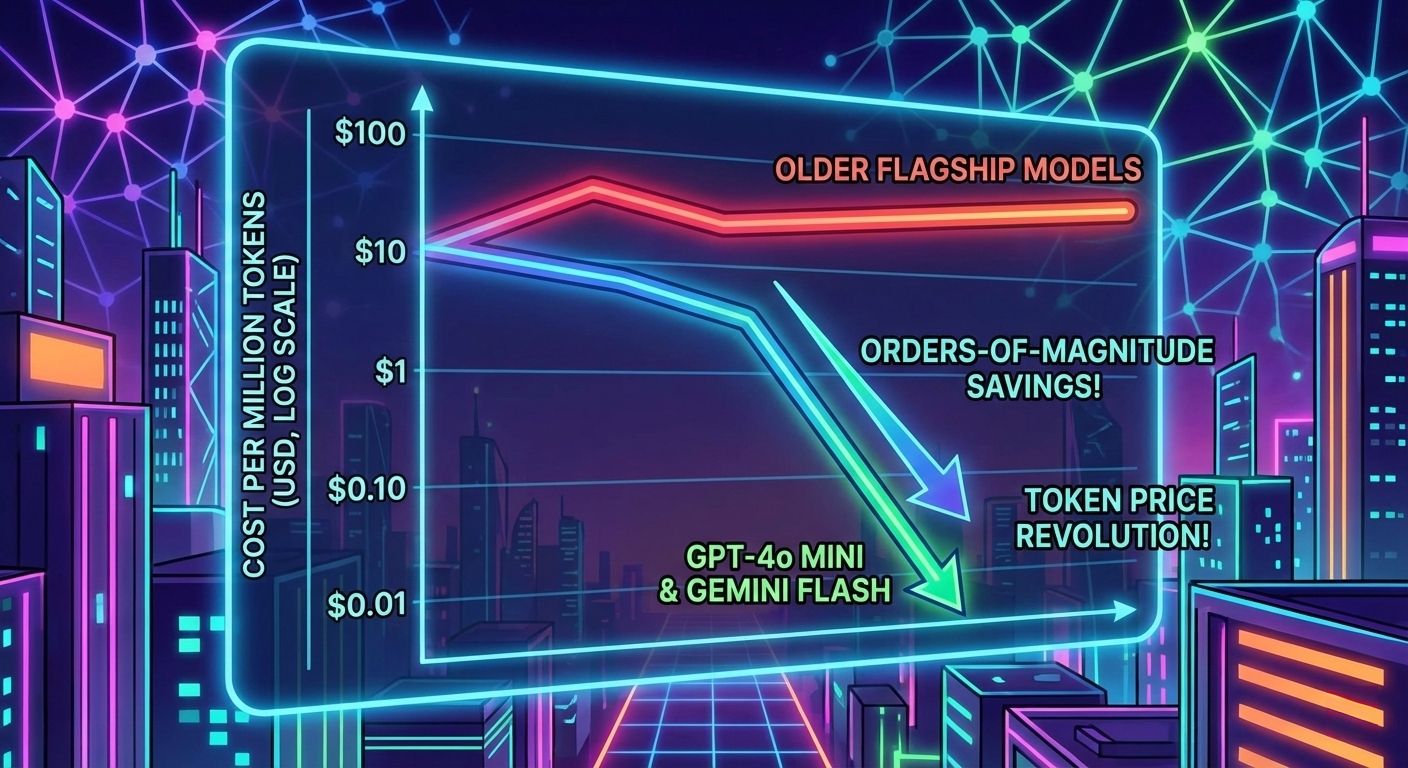
Newer model variants like GPT-4o Mini and Gemini Flash deliver near-state-of-the-art results at ultra-low token pricing compared to older flagship models.
These cutting-edge models have been optimized to provide exceptional performance without increasing costs, making them an attractive option for businesses and developers looking to integrate AI-powered solutions into their workflows.
Algorithmic and architectural efficiency gains contribute to sustained drops in inference costs without proportional performance loss. This means that newer models can handle complex tasks with ease, while also saving a significant amount of money in the process.
In fact, some ultra-efficient models can cost orders of magnitude less per million tokens than leading flagship models, making them an attractive option for those looking to achieve lower prices.
One of the key benefits of these newer models is their ability to provide high-quality results at a fraction of the cost of older models. This is especially important for businesses that are looking to integrate AI-powered solutions into their workflows, but may not have the budget to spare.
By leveraging the power of newer models, businesses can achieve AI cost reduction without sacrificing performance, making them an attractive option for those looking to stay ahead of the curve.
The impact of lower token pricing can be significant, with businesses able to save thousands of dollars per year and use better models at the same time.
This can be especially beneficial for startups and small businesses that may not have the budget to spare. By choosing newer models, businesses can achieve AI cost reduction without sacrificing performance, making them an attractive option for those looking to stay ahead of the curve.
Broader AI Adoption Driven by Declining Query Costs
The AI revolution has reached the tipping point, and it’s definitely also thanks to one simple yet powerful factor: declining query costs. As AI prices continue to plummet, more businesses are jumping on the bandwagon, leveraging the technology to drive innovation and growth.
In the past, AI was often seen as a luxury only the biggest players could afford. But with query costs decreasing dramatically, the barrier to entry has been lowered, making AI more accessible to companies of all sizes. This shift has been nothing short of remarkable, with AI adoption rates skyrocketing across industries.
One of the primary drivers of this trend is the increasing demand for high-volume applications, such as real-time personalization and customer service chatbots. These use cases require a significant amount of computing power and data processing, which can be costly.
However, with the ongoing AI cost reduction, many businesses are now able to afford the necessary infrastructure to support these applications.
The result is a world where real-time personalization, intelligent customer service and other high-volume applications are no longer the exclusive domain of tech giants.
Many businesses of different sizes can now tap into the power of AI to drive growth and stay ahead of the competition.
Whether you’re a small startup or a large enterprise, the benefits of AI adoption are now within reach – plus the technology is getting better and cheaper at the same time.

Training and Infrastructure Costs Remain High
The rapid advancement of AI technology has brought about significant improvements in query pricing, making it more accessible and affordable for businesses to integrate AI into their operations.
However, a different story unfolds when it comes to training and infrastructure costs. Despite the drop in query pricing, training and infrastructure costs remain stubbornly high, posing a major challenge for organizations looking to harness the full potential of AI.
While competitive hardware and optimization have helped to partially offset this issue, the underlying problem persists. The cost of training and deploying AI models can become a significant barrier to entry for many businesses, limiting their ability to innovate.
In the last few years, the prices was always going down, but the high costs of training and infrastructure are not expected to decrease significantly in the near future. Even with advancements in the field, it can become a problem if training will be so expensive that the token pricing would have to go up.
There are many promising area of focus for AI cost reduction, which involves the use of techniques such as model pruning, knowledge distillation and transfer learning to reduce the computational resources required for training and deployment.
By implementing AI cost reduction strategies, big companies can significantly reduce their training and infrastructure costs, making it more feasible to integrate AI into their products.
However, achieving meaningful AI cost reduction requires a deep understanding of the underlying technology and a commitment to experimentation and innovation.
As the AI landscape continues to evolve, it’s clear that training and infrastructure costs will remain a major challenge for this ever growing field.
Expecting Continued Price Declines
The AI landscape is poised for significant changes, and even with some issues poping, like growing hardware and training costs, it is still expected that prices will continue to decline in the industry.
By 2026, competition is expected to intensify, driving prices down even further as companies scramble to stay ahead in the market. This shift towards AI services with ever-lower per-query fees will revolutionize the way businesses operate, making AI more accessible and affordable for companies of all sizes.
The pace of AI cost reduction is expected to remain rapid, with innovations in technology and increasing competition pushing prices down.
This trend will have a profound impact on the industry, enabling businesses to adopt AI solutions at a fraction of the cost they would have paid just a few years ago.
Whether it’s chatbots, predictive analytics or customer service tools, the cost savings will be substantial, allowing businesses to focus on innovation and growth rather than budget constraints.
Not all aspects of the industry will benefit from this trend. As AI companies demand more powerful hardware components, such as RAMs and SSDs, prices for these components may actually increase.
This could lead to a paradoxical situation where the cost of AI services declines, but the cost of the hardware needed to run these services rises. Despite this potential challenge, the overall trend of continued price declines is expected to remain a key driver of innovation in the AI industry.
By making AI more accessible and affordable, businesses will be able to harness the power of AI to drive growth, improve customer experiences, and deliver innovative solutions.
Do you think that the current pace of lowering prices is sustainable? Let us know in the comment section!