

In some cases, traditional approaches fall short. Retrieval-Augmented Generation (RAG) has become one of the most effective techniques for improving the accuracy of Large Language Models (LLMs). Instead of relying solely on the model’s training data, a RAG memory pipeline retrieves relevant information from external sources-such as company documentation, PDFs, customer records, or internal knowledge bases-and provides it as additional context for the model.
This simple idea dramatically reduces hallucinations and allows AI assistants to answer questions using up-to-date, domain-specific information. As a result, RAG has become a standard component in production AI systems.
However, traditional RAG has a significant limitation that quickly becomes apparent when building conversational AI agents: it has no long-term memory. RAG memory aims to solve that.
Imagine an account manager using an AI assistant throughout the week. On Monday, they discuss a customer’s contract renewal. On Wednesday, they review previous support tickets. On Friday, they ask the assistant to prepare for another meeting with the same client.
From the human’s perspective, these conversations are all connected. From the AI’s perspective, however, each new chat session often starts with a blank slate.
Once the previous session ends, everything that happened during the conversation is forgotten.
Many applications attempt to solve this by storing the full conversation history in a database and replaying it back into the model on every request. While this technically works, it introduces several problems:
- Prompt sizes grow continuously.
- API costs increase.
- Latency becomes higher.
- Important details become buried inside thousands of tokens.
- Eventually the context window is exceeded.
Simply increasing the context window is not a sustainable solution. Even models capable of processing hundreds of thousands of tokens still require more computation as prompts grow larger, making them slower and more expensive.
Instead of asking the model to remember everything, a better approach is to remember only what matters.
This is where RAG memory comes into play.
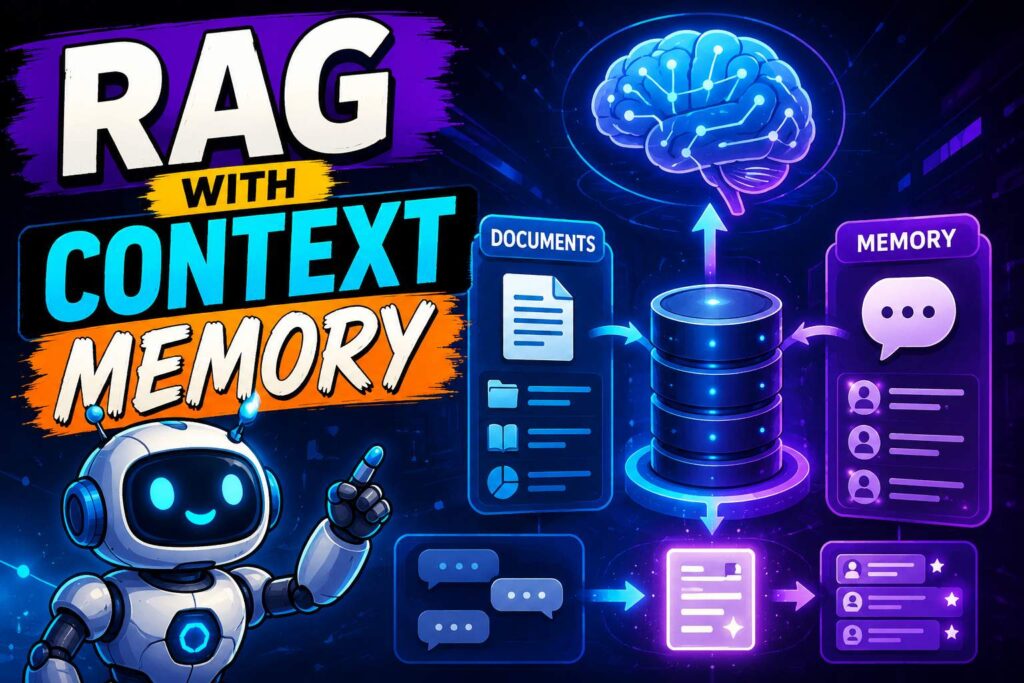
Rather than storing raw conversation transcripts forever, we periodically summarize conversations into concise episodic memories, embed those summaries, and store them alongside our document vectors. When the user returns days or weeks later, the system retrieves only the memories that are relevant to the current conversation.
The result is an AI assistant that not only retrieves knowledge from documents but also remembers previous interactions across completely separate chat sessions.
In this article, we’ll build exactly that-a production-ready RAG memory system using FastAPI, LangChain, Groq, and Pinecone.
Designing a Two-Tier Vector Database
The first architectural decision is determining where both documents and conversational memories should be stored.
A common approach is to maintain separate vector databases-or at least separate indexes-for each type of information. One index stores documentation, while another stores conversational memory. That’s what sets traditional and RAG memory systems.
Although this works, it introduces additional operational complexity. Every new index requires separate management, API connections, monitoring, permissions, and infrastructure configuration. As applications scale, these overheads become increasingly difficult to maintain.
A much cleaner solution is to use Pinecone Namespaces.
Namespaces allow us to partition a single vector index into multiple isolated logical spaces. Every search query is scoped to a particular namespace, ensuring that document vectors never interfere with conversation memories while still sharing the same infrastructure.
Our architecture uses two namespaces:
Documents Namespace
The "documents" namespace stores relatively static business information, such as:
- Customer profiles
- Internal documentation
- Product manuals
- Historical meeting notes
- Knowledge base articles
These vectors are typically populated through an ingestion pipeline or ETL process.
Memory Namespace
The "memory" namespace stores dynamic conversational summaries generated by the AI itself.
Instead of saving every individual message, we periodically summarize an entire conversation and store only the condensed representation. These summaries become long-term memories that can later be retrieved whenever they are relevant. It is the basis of RAG memory system.
The resulting architecture looks like this:
                  ┌─────────────────────────────────────────┐
                  │          Pinecone Single Index          │
                  │         (Dimension: 1536, Cosine)       │
                  └────────────────────┬────────────────────┘
                                       │
                    ┌──────────────────┴──────────────────┐
                    ▼                                     ▼
        ┌───────────────────────┐             ┌───────────────────────┐
        │ Namespace: "documents"│             │ Namespace: "memory"   │
        ├───────────────────────┤             ├───────────────────────┤
        │ • CRM Data            │             │ • Episodic Summaries  │
        │ • Product Docs        │             │ • Chat History        │
        │ • Meeting Notes       │             │ • User Preferences    │
        │ • Traditional RAG     │             │ • RAG memory upgrade  │
        └───────────────────────┘             └───────────────────────┘
This separation provides another important benefit: metadata filtering.
When searching documents, we might filter by fields such as:
- company
- department
- document type
When searching memories, we instead filter by:
- user ID
- session ID
- memory type
This ensures users only retrieve their own conversation history while still accessing the correct business documentation.
The two namespaces remain logically independent while sharing the same vector database.
Building an Effective Data Ingestion Pipeline
Even the best retrieval system is only as good as the data it indexes.
One mistake developers often make is embedding structured data directly from CSV files or relational databases. Although embedding models can process this information, they generally perform much better when the input resembles natural language.
Consider a customer record stored as a CSV row:
| Company | Industry | Contract Value | Renewal Date |
| Acme Corp | Manufacturing | 120000 | 2026-10-15 |
Humans can immediately interpret this table.
Embedding models, however, are optimized for semantic text rather than relational data.
Instead of embedding the raw row, we translate it into a descriptive sentence:
Company Acme Corp operates in the Manufacturing industry. The account contract value is $120,000 with a renewal date of 2026-10-15. The assigned account manager is Alice Vance.
This richer representation captures relationships between the fields, making semantic retrieval significantly more effective.
A simplified implementation looks like this:
def load_customers_as_strings(file_path: Path) -> list[dict]:
    df = pd.read_csv(file_path)
    documents = []

    for _, row in df.iterrows():
        company = str(row["company"]).strip()

        text = (
            f"Company {company} operates in the "
            f"{row['industry']} industry. "
            f"The account contract value is "
            f"${row['contract_value']} with a "
            f"renewal date of {row['renewal_date']}. "
            f"The assigned account manager is "
            f"{row['account_manager']}."
        )

        metadata = {
            "company": company,
            "text": text,
            "doc_type": "customer_profile"
        }

        documents.append({
            "text": text,
            "metadata": metadata
        })

    return documents
Although this example uses a CSV file, production systems usually retrieve data from CRM platforms, internal APIs, or event-driven architectures.
For example, a webhook from Salesforce or HubSpot could trigger this ingestion pipeline whenever:
- a contract value changes,
- a new customer is added,
- meeting notes are updated,
- or account ownership changes.
Each update generates a fresh embedding and upserts it into the "documents" namespace, ensuring the AI assistant always retrieves the latest information without rebuilding the entire index.
Creating Long-Term Episodic Memory
Static documents solve only part of the problem.
An AI assistant also needs to remember what happened during previous conversations.
Rather than storing every individual message forever, we periodically compress an entire conversation into a concise summary. This mirrors how humans naturally remember experiences-we rarely recall every sentence of a meeting, but we do remember its important outcomes.
Whenever a conversation reaches a predefined checkpoint or becomes inactive, the complete transcript is sent to the LLM with instructions to summarize only the information worth remembering.
The prompt focuses on extracting:
- important decisions,
- customer preferences,
- unresolved action items,
- changing requirements,
- significant contextual information.
Everything else is intentionally discarded.
Once generated, the summary is embedded and stored inside the "memory" namespace using metadata similar to the following:
# RAG memory
metadata = {
    "user_id": user_id,
    "session_id": session_id,
    "text": summary_text,
    "doc_type": "memory"
}
An important design choice is using the session ID as the vector’s primary identifier.
Pinecone automatically overwrites vectors with the same ID.
This means that if a conversation is summarized after five messages and later grows to ten messages, the updated summary simply replaces the previous version instead of creating duplicate memories.
This strategy keeps the memory namespace compact, avoids redundant vectors, and ensures every session is represented by a single, up-to-date summary.
Instead of accumulating hundreds of nearly identical vectors over time, the database stores only the latest understanding of each conversation.
Retrieving the Right Memories
Once we have both documents and episodic memories stored in our vector database, the next challenge is deciding which memories should be retrieved for each user query.
At first glance, this seems straightforward. We can simply embed the user’s latest message, search the "memory" namespace, and return the most similar summaries. In practice, however, there are a few important design decisions that significantly affect the quality of the responses.
Why Retrieve Multiple Memories Instead of Just One?
Suppose a sales representative has been working with the same customer for six months. During that time, they have held numerous meetings covering different topics:
- An initial discovery call
- Product demonstrations
- Pricing negotiations
- Technical implementation
- Support discussions
Each of these conversations is summarized into its own episodic memory.
If we retrieve only the single closest memory (top_k = 1), we risk missing valuable historical context. The latest meeting may discuss pricing, while an earlier meeting contains critical implementation requirements that are still relevant today.
Instead, retrieving the top three most relevant summaries gives the language model a broader understanding of the customer’s history without overwhelming its context window.
This strikes a practical balance between completeness and efficiency. The model receives enough historical context to identify recurring themes and connect events across multiple conversations while still keeping prompts compact.
Preventing Irrelevant Memories
There is another subtle problem with vector search that many developers encounter during their first RAG implementation.
Vector databases always return the nearest neighbors-even when none of them are actually relevant.
Imagine a completely new user asking their very first question.
If we request the three nearest vectors, Pinecone will still return three results. They simply happen to be the mathematically closest vectors in the embedding space, even though they have nothing to do with the current conversation.
Without additional filtering, these unrelated summaries become noise inside the prompt and can confuse the language model.
To solve this problem, we introduce cosine similarity thresholding.
Instead of accepting every returned vector, we only keep memories whose similarity score exceeds a predefined threshold. During development, we found that a threshold of 0.70 produced a good balance between recall and precision for our embedding model.
A simplified implementation looks like this:
# Filter matches by similarity score threshold for RAG memory
threshold = 0.0 if is_mock else 0.70

memories = []

for match in matches:
    score = match.get("score", 0.0)

    if score < threshold:
        logger.info(
            f"Discarding match {match.get('id')} "
            f"due to low similarity: {score:.4f}"
        )
        continue

    metadata = match.get("metadata", {})
    text = metadata.get("text", "")

    if text:
        memories.append(text)
During testing we encountered an interesting edge case.
Our local development environment uses deterministic mock embeddings whenever API keys are unavailable. Because these vectors are essentially random unit vectors, their similarity scores are close to zero regardless of the input text.
Applying a production threshold of 0.70 caused every memory lookup in our automated tests to fail.
To avoid maintaining separate implementations, we simply detect whether the RAG memory application is running in mock mode and temporarily disable thresholding.
Although this condition exists purely for testing, it demonstrates an important principle: production systems often require slightly different behavior during development while still sharing the same overall architecture.
Orchestrating Memory Retrieval with LangChain
With our document and memory retrieval mechanisms in place, the final step is orchestrating them into a single conversational workflow.
One important design decision is when memories should be retrieved.
Rather than fetching memories after the model generates a response, we retrieve them before every LLM invocation. This ensures the model has access to all relevant historical information while generating its answer.
The overall request lifecycle looks like this:
[POST /chat]
    │
    ▼
1. Initialize Session
    │
    ▼
2. Store Current User Message
    │
    ▼
3. Retrieve Relevant Memories
       └─ Query "memory" namespace
    │
    ▼
4. Retrieve Relevant Documents
       └─ Query "documents" namespace
    │
    ▼
5. Construct System Prompt
       └─ Instructions
       └─ Episodic Memories
       └─ Document Context
    │
    ▼
6. Invoke LangChain + ChatGroq
    │
    ▼
7. Store Assistant Response
    │
    ▼
8. Check Whether Conversation Should Be Summarized
This architecture provides two major benefits.
First, the language model receives only the information that is relevant to the current request, keeping prompts concise and reducing inference costs.
Second, both retrieval pipelines remain completely independent. Document retrieval supplies factual business information, while episodic memory provides conversational context and historical continuity. The language model combines these two sources seamlessly within a single prompt.
To manage inactive conversations, we also run a background monitoring task using FastAPI’s lifespan context manager.
Every few minutes, the monitor scans for sessions that have been inactive for a configurable period. Before removing them from server memory, the conversation is summarized one final time and written to the "memory" namespace.
async def stale_session_monitor(
    interval_seconds: float = 300.0,
    stale_threshold_seconds: float = 1800.0,
):
    while True:
        await asyncio.sleep(interval_seconds)

        stale_ids = get_stale_sessions(
            stale_threshold_seconds
        )

        for session_id in stale_ids:
            session_data = active_sessions.get(session_id)

            if not session_data:
                continue

            save_session_summary(
                session_data["user_id"],
                session_id,
                session_data["messages"],
            )

            remove_session(session_id)
This approach ensures that valuable conversations are never lost while keeping the application’s in-memory session store lightweight.
Engineering Challenges and Lessons Learned
Building a production-ready RAG memory system involved more than simply connecting libraries together. Along the way, we encountered several implementation challenges that are worth highlighting because they are likely to affect other developers building similar systems.
Pinecone’s SDK Migration
Our first obstacle appeared before the application even started.
The project initially depended on the legacy pinecone-client package, which has since been replaced by the official pinecone SDK.
Attempting to run the application produced the following error:
Exception:
The official Pinecone python package
has been renamed from pinecone-client
to pinecone.
Although the fix was relatively simple-removing the deprecated dependency, installing the new package, and rebuilding the environment-it served as a reminder that modern AI ecosystems evolve rapidly. Keeping dependencies up to date is essential for maintaining production systems.
State Isolation During Testing
The second issue was considerably more subtle.
Our automated tests successfully ingested customer data, yet subsequent chat requests failed to retrieve any vectors.
The root cause was that every call to get_pinecone_index() created a brand-new instance of our mock database. As a result, the ingestion pipeline and the test suite were unknowingly interacting with different in-memory databases.
The solution was to implement a Singleton pattern:
_mock_index_instance = None

def get_pinecone_index():
    global _mock_index_instance

    if is_placeholder(PINECONE_API_KEY):
        if _mock_index_instance is None:
            _mock_index_instance = MockPineconeIndex()

        return _mock_index_instance

    ...
Although this issue only affected local testing, it highlights an important lesson: ensuring consistent state across components is just as important as implementing the retrieval logic itself.
Best Practices for Production RAG Memory
As conversational AI systems grow in complexity, maintaining a clean and efficient memory store becomes increasingly important.
The following practices have proven valuable when deploying episodic memory in production environments:
- Keep memories concise. Long summaries defeat the purpose of reducing context size. Focus on decisions, preferences, unresolved tasks, and important facts rather than complete transcripts.
- Regularly tune similarity thresholds. Different embedding models produce different similarity score distributions. A threshold that performs well with one model may be too restrictive-or too permissive-for another.
- Delete obsolete data. When customer records are removed or users are deleted, remember to clean both the
"documents"and"memory"namespaces to avoid stale or orphaned vectors. - Limit active conversation history. There is little benefit in keeping hundreds of raw messages in memory once they have been summarized. Periodically archive conversations and rely on episodic retrieval instead.
- Treat memory as a product feature. Users quickly begin to expect continuity across conversations. Investing in a reliable memory architecture significantly improves the perceived intelligence and usefulness of an AI assistant.
Final Thoughts
Traditional RAG systems excel at retrieving facts, but they struggle to maintain continuity across conversations. As AI assistants become increasingly integrated into business workflows, remembering previous interactions is no longer a luxury-it is an expectation.
An episodic RAG memory architecture bridges this gap by combining static document retrieval with long-term conversational memory. Rather than overwhelming the language model with ever-growing chat histories, we preserve only the information that matters: important decisions, user preferences, unresolved tasks, and evolving context.
By leveraging Pinecone Namespaces, LangChain orchestration, FastAPI background tasks, and semantic similarity filtering, we can build AI agents that remain efficient while remembering relevant interactions across days, weeks, or even months.
Although context windows continue to expand, larger prompts alone are unlikely to solve the problem of long-term memory. Intelligent summarization and targeted retrieval remain a more scalable, cost-effective, and maintainable solution.
As AI applications continue to evolve from simple chatbots into persistent digital assistants, architectures like this will become an increasingly important part of production systems. Building memory into your RAG memory pipeline today lays the foundation for AI agents that don’t just answer questions-they build lasting context, learn from past interactions, and provide a far more natural conversational experience.