

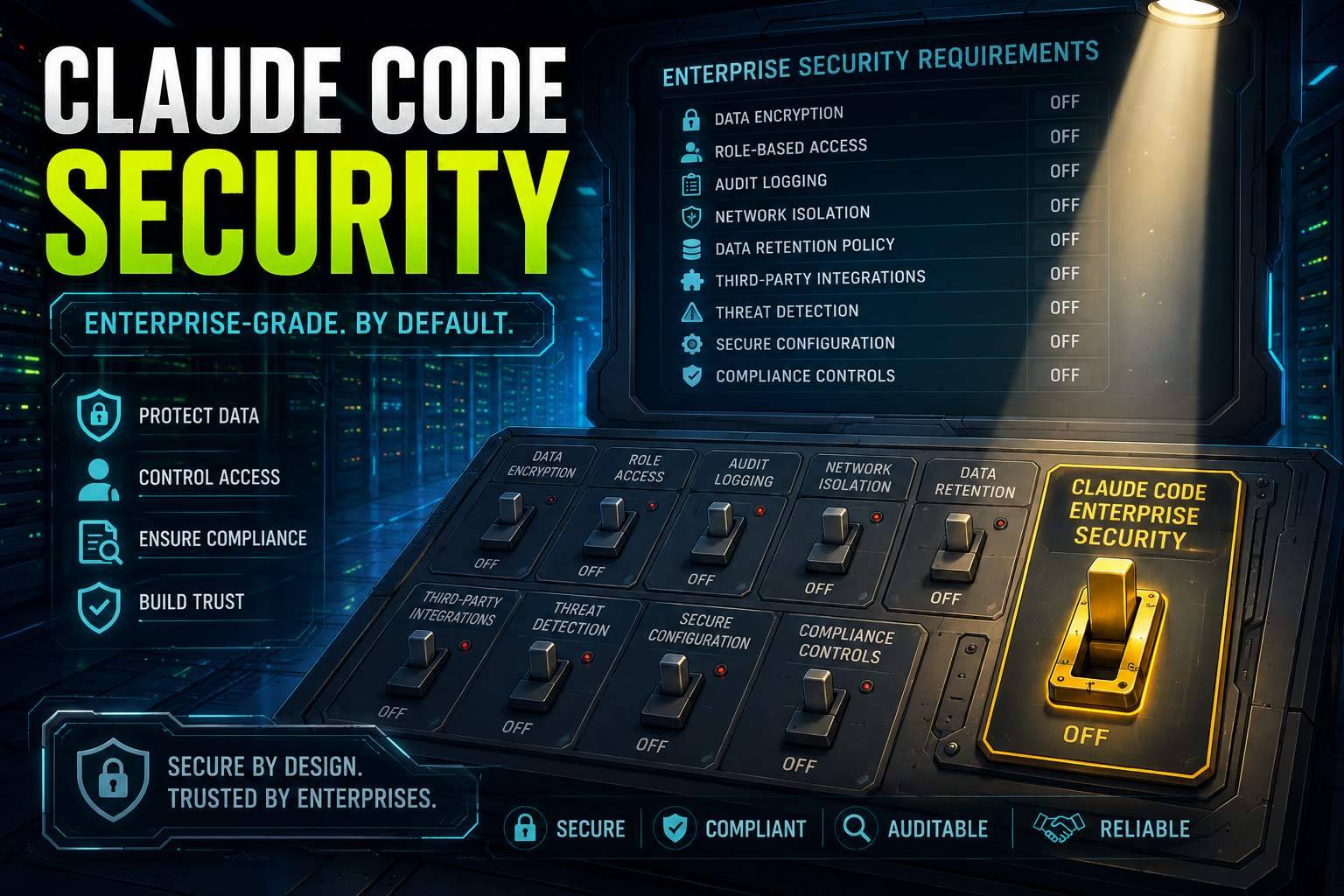
The wrong question to ask about Claude Code enterprise security is “is it secure?” It’s a question that often leads to vague reassurances and a false sense of security. The right question is “how do we configure it so our security requirements are actually enforced?” This is where the real power of Claude Code enterprise security lies.
In Claude Code enterprise security, every meaningful control is opt-in and off by default. This might seem counterintuitive at first, but it’s actually a more secure approach. By default, Claude Code enterprise security doesn’t impose unnecessary restrictions on your team’s workflow. Instead, it gives you the flexibility to choose which security controls are relevant to your specific use case.
For example, if you’re working on a project that requires strict access controls, you can easily turn on the relevant features in Claude Code enterprise security. But if you’re working on a proof-of-concept project with a tight deadline, you can disable those controls and focus on delivering results.
The opt-in approach also eliminates the risk of over-engineering security controls that end up getting in the way of your team’s productivity. It’s a more nuanced approach to security that acknowledges that different projects have different needs. With Claude Code enterprise security, you’re not forced to adopt a one-size-fits-all solution. Instead, you get to choose the security controls that make sense for your specific use case.
By taking a thoughtful and measured approach to security, you can ensure that your team’s security requirements are actually enforced, without sacrificing productivity or flexibility. That’s the power of Claude Code enterprise security.
Three-Layered Defense
In the world of cybersecurity, Claude Code enterprise security relies on a robust three-layered defense mechanism to safeguard its users. This multi-layered approach ensures that every angle is protected, making it virtually impossible for malicious actors to breach the system.
At the core of this defense lies Permissions. This layer decides which tools and commands can run within Claude Code enterprise security, thereby limiting the potential attack surface. By granting only necessary permissions, we minimize the risk of unauthorized access and ensure that users can only perform actions that are authorized.
Next, we have MCP scoping, which acts as a gatekeeper, controlling which external systems are reachable within Claude Code enterprise security. This ensures that even if an attacker manages to bypass the permissions layer, they will still be unable to access sensitive systems or data. By carefully defining the scope of external interactions, we prevent lateral movement and further reduce the attack surface.
Finally, we have OS-level sandboxing, which enforces strict filesystem and network boundaries. This layer creates a secure environment for users to operate within, isolating them from the underlying system and preventing any potential exploits from spreading. By sandboxing users, we ensure that even if an attacker gains access to a user’s session, they will be unable to escape the sandbox and launch further attacks.
The combination of these three layers provides an impenetrable defense for Claude Code enterprise security. With permissions controlling access, MCP scoping limiting external interactions, and OS-level sandboxing isolating users, we have created a fortress that is virtually impossible to breach.

Sandboxing
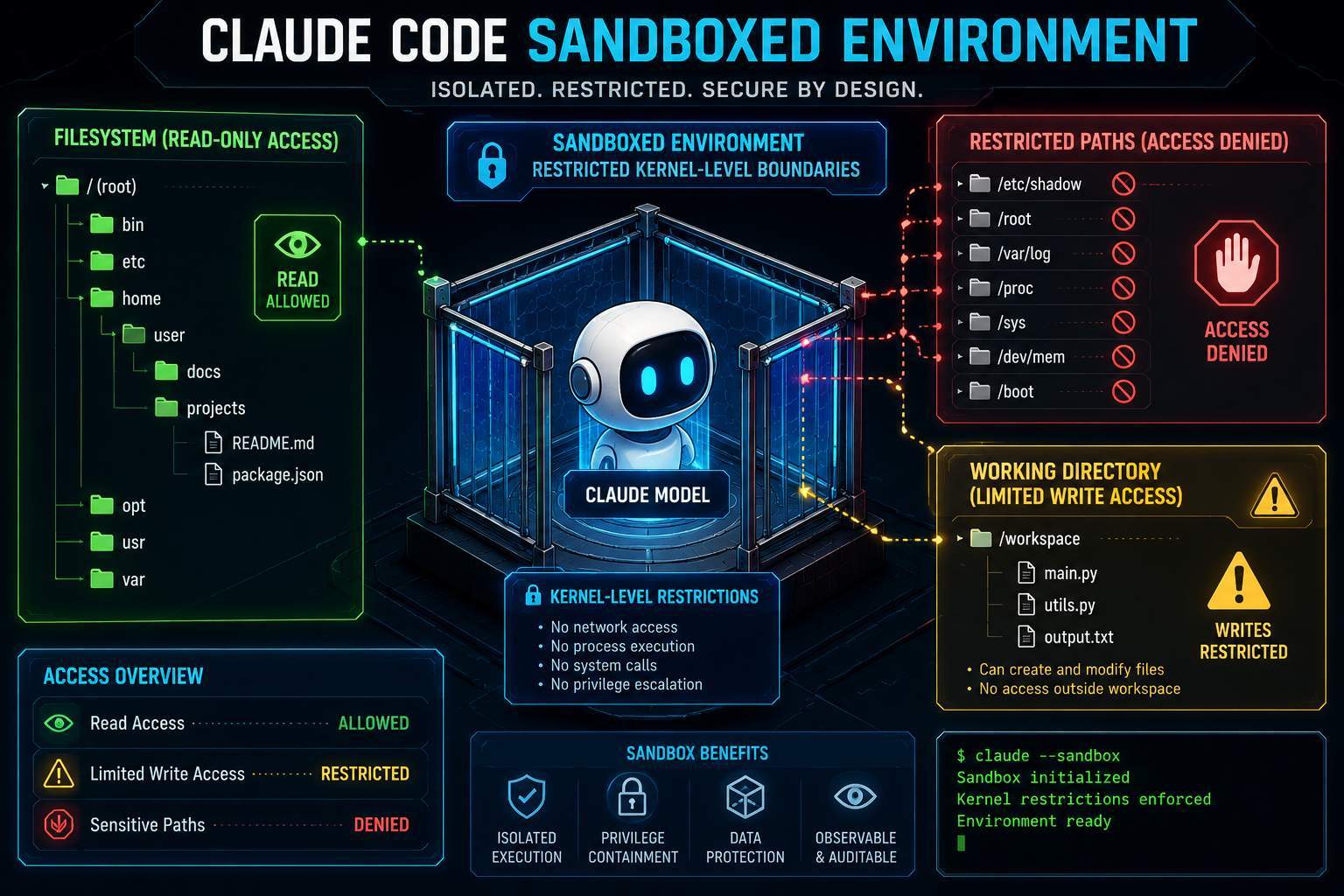
Imagine your model is a free-spirited artist, eager to express itself without boundaries. But what if that same model is part of a sensitive project, like a financial forecasting tool? You need to keep it in check, and that’s where sandboxing comes in. This powerful security feature uses macOS Seatbelt and Linux seccomp/namespaces to enforce boundaries at the kernel level. It’s like a digital fence that prevents your model from straying into unauthorized areas.
Even if your model is talked into doing something it shouldn’t, sandboxing has got your back. This advanced security measure ensures that your model stays within the predetermined boundaries, keeping your sensitive data safe from prying eyes. In the world of Claude Code enterprise security, sandboxing is a vital component of our defense against potential threats.
But what exactly does sandboxing do? Simply put, it restricts writes to the working directory, preventing your model from making any unwanted changes. However, read access remains unrestricted, giving your model the freedom to access the entire filesystem – except for the paths you specifically deny. This balance between security and flexibility is what makes sandboxing so effective.
In the hands of an experienced developer, sandboxing is a powerful tool for building robust and secure models. By leveraging the strengths of macOS Seatbelt and Linux seccomp/namespaces, you can create models that are not only secure but also efficient and reliable. With sandboxing on your side, you can rest assured that your project is protected from potential threats and vulnerabilities.
Network Egress Control
Route the sandbox through a proxy with domain allowlisting in Claude Code enterprise security.
Ensuring your development environment is secure is crucial in today’s threat landscape. One way to achieve this is by implementing network egress control. This powerful feature in Claude Code enterprise security allows you to restrict outbound traffic from your sandbox, preventing potential security breaches.
To get started, you’ll need to configure your sandbox to route traffic through a proxy. This will enable domain allowlisting, a feature that only allows traffic to specific, approved domains. No longer will malicious scripts be able to phone home to their command and control servers.
But that’s not all. New domain requests will trigger a prompt, giving you the opportunity to review and approve each request on a case-by-case basis. This ensures that your sandbox remains secure and only communicates with trusted domains.
What’s more, all child processes will inherit the restrictions set by the parent process. This means that even if a malicious script attempts to spawn a child process to make an unauthorized request, it will be blocked by the restrictions in place.
A compromised build script can’t phone home in Claude Code enterprise security. With network egress control, you can rest assured that your development environment is secure and protected from potential security threats. By implementing this feature, you’ll be able to focus on writing code without worrying about the security implications.
By taking control of your network egress, you’ll be able to prevent security breaches and protect your intellectual property. Don’t let a compromised build script compromise your security. Implement network egress control today and keep your Claude Code enterprise security safe.

Policy Enforcement and Visibility
Enterprise-managed settings pushed via MDM make the policy verifiable rather than aspirational in Claude Code enterprise security. No longer do teams have to wonder if everyone is following the rules or just pretending to. With settings enforced at the device level, you can trust that your organization is in compliance.
But what happens when something goes wrong? That’s where visibility comes in. Running `/status` shows a “Setting sources” line listing every active layer and its delivery channel. This is the evidence your auditor actually wants in Claude Code enterprise security. It’s the proof that you’re doing more than just talking the talk – you’re walking the walk.
But what about those pesky “shadow-AI” tools that your devs just can’t seem to resist? Close the shadow-AI hole rather than blocking tools outright in Claude Code enterprise security. Give teams the flexibility they need to do their jobs without compromising your organization’s security.
To take it a step further, enforce SSO and SCIM to ensure that only authorized users have access to your organization’s resources. And use tenant restrictions via header injection to block personal Claude accounts on the corporate network. It’s a simple yet effective way to keep your organization’s data safe.
And let’s not forget about making it easy for teams to do the right thing. Give them a paved road (approved MCP allowlist, dev containers, a starter `settings.json`) so the secure option is also the easiest one. By doing so, you’ll not only improve security but also increase productivity and reduce frustration. It’s a win-win for everyone involved.

Cowork Governance and Risks
When it comes to securing your organization’s data and workflows, transparency and visibility are key. Unfortunately, Anthropic’s architecture doesn’t prioritize security in every tier, even Enterprise. This means that cowork activity is excluded from their Audit Logs, Compliance API, and Data Exports on every tier – including Enterprise.
This lack of visibility leaves you with limited options for monitoring and securing your sensitive information. In contrast, OpenTelemetry export to your SIEM is the only native visibility channel available in Claude Code enterprise security. This means you’re left relying on a single channel to keep an eye on your data, which can be a daunting task.
Moreover, cowork also shifts data-at-rest protection onto your endpoints. This can lead to increased security risk and potential data breaches. With so many uncertainties surrounding data security, it’s no wonder that organizations are hesitant to adopt cowork solutions.
However, the tide is turning. With the right guardrails in place, the adoption argument for Claude Code enterprise security writes itself. By providing a secure and controlled environment, organizations can confidently integrate cowork into their workflows. In fact, sandboxing has been shown to cut permission prompts by a whopping 84%. This significantly reduces friction and allows engineers to stay focused on their tasks without unnecessary interruptions.
By empowering your engineers to work within sanctioned paths, you can minimize the risk of data breaches and ensure compliance. For instance, engineers stop clicking Approve on `git status` and stay inside the sanctioned path in Claude Code enterprise security. This not only boosts productivity but also strengthens your organization’s security posture.
