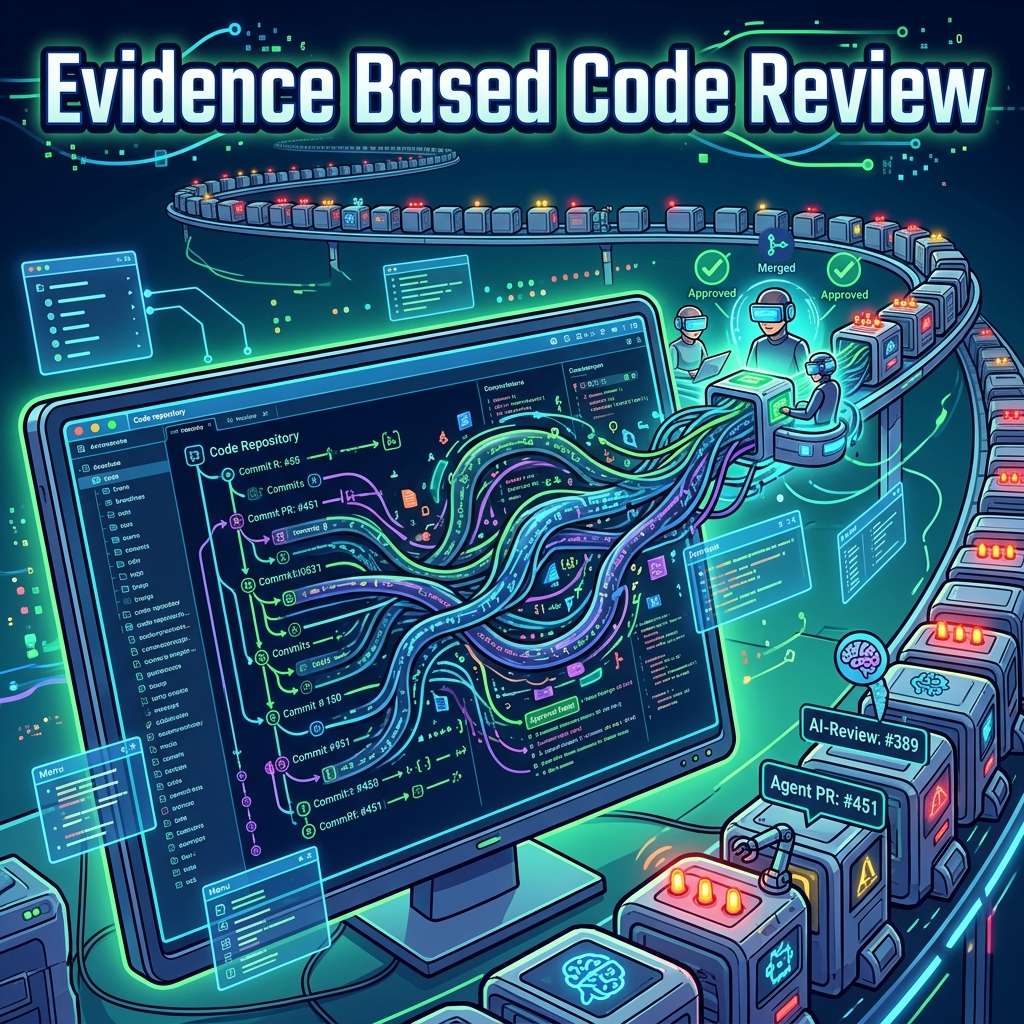
As the industry continues to evolve, one thing is clear: the evidence based code review process has become a critical component of software development. But what happens when this process, designed to ensure the highest quality code, starts to bottleneck?
The numbers don’t lie. 2026 has seen a significant spike in code review time, with some teams reporting a several-fold increase. Meanwhile, task throughput has also risen, putting even more pressure on the review process. The question on everyone’s mind is: what’s causing this bottleneck?
A closer look at pull requests reveals some telling trends. AI-assisted pull requests, once hailed as a game-changer, are now significantly larger than their non-AI counterparts. This is likely due to the increased complexity of the code generated by AI tools. At the same time, reviewer pickup times for these PRs are lagging behind, with some waiting much longer for feedback.
What’s behind this delay? One possible culprit is the growing number of manual reviews required for AI-assisted PRs. As AI-generated code becomes more prevalent, human reviewers are struggling to keep up with the complexity of the code. The result is a bottleneck in the code review process, where quality and speed are equally important.
The shift in the evidence based code review process has significant implications for software development teams. To stay ahead of the curve, teams must find ways to streamline their review process, prioritize reviewer efficiency, and adapt to the changing landscape of AI-assisted code. The stakes are high, but the reward is worth it: faster, higher-quality code that sets your team up for success.
When a Diff is Too Large for Human Heads
Line-by-line reading becomes theatre when a diff is too large. The reviewer’s real question shifts from ‘is this line correct?’ to ‘what proof do I have that this change does what was asked and breaks nothing?’.
Imagine your codebase as a living, breathing creature, and every commit is a tiny addition to its anatomy. At first, the changes are manageable – you can see the entire creature, even if it’s still a bit rough around the edges. But as time passes, the creature grows, and so does the complexity of its changes. Your commits become a jumbled mess of code, and the reviewer’s task shifts from verifying each line to deciphering the entire diff.
It’s no longer just about saying ‘yes’ or ‘no’ to a line; it’s about navigating a dense forest of changes. The reviewer must ask themselves, ‘How can I be sure that this change is correct and doesn’t introduce a new bug?’ They need to consider the entire ecosystem, from the line in question to the ripple effects it might have elsewhere in the code.
This is where automated testing and continuous integration come in. By running tests and validating code changes, you can provide proof that the changes are correct and don’t break anything. This not only saves time but also reduces the likelihood of errors. In short, automated testing is your safety net, catching any mistakes and ensuring that the changes you make are reliable and maintainable.

The Evidence Bundle: From PR to Merge
Every pull request tells a story, but the best ones come with proof. This change makes three promises: users can filter search results by date range, results are paginated for performance, and invalid date ranges no longer fail silently. The question a reviewer should be asking isn’t whether the code looks right – it’s whether the evidence backs those promises up.
The test report offers the first answer. Automated tests exercise 99.5% of the changed lines, and coverage in the affected areas moved up 2.1 percentage points. Manual passes over search and performance turned up nothing. But coverage alone has never been a guarantee of correctness, which is why the benchmarks matter more: rendering times for search results improved by 35%, and memory usage dropped by 25%. Both gains trace back to pagination rather than to anything incidental.
What does the change actually do at runtime? Following a single request through the new code makes it concrete. A user submits a query with a date range, the request routes to the search endpoint, the endpoint calls the new paginated search function, that function returns results with error handling applied, and the paginated response makes its way back to the user. Five steps, no hidden branches, no surprises.
Security tells a similarly quiet story. The SAST scan surfaced no vulnerabilities in the new code, and the dependency scan found nothing new in the updated libraries. Attached to the PR are before-and-after screenshots of the search results page alongside API recordings of the full request and response cycle – the kind of artifacts that let a reviewer verify behaviour without reconstructing it from the diff.
Then there’s production, the reviewer that can’t be argued with. The canary deployment ran at a 99.9% success rate with no reports from canary users, and deploy telemetry showed a 20% reduction in deployment time. Taken together, the bundle answers the only question that really matters at merge time: not “did someone read this?” but “do we have reason to believe it works?”

Avoiding the Circular Reasoning Trap
When you’re the sole author of both the code and its tests, relying solely on green Continuous Integration (CI) is a recipe for disaster. The truth is, green CI only proves self-consistency. It tells you that the code runs without errors, but it doesn’t guarantee that it’s correct or behaves as expected in real-world scenarios.
In such cases, you need to lean on more robust testing methods. Mutation testing, for instance, involves introducing small changes into your code and verifying that the tests fail as expected. This approach helps identify weaknesses in your test suite and ensures that the code is robust and fault-tolerant.
Property-based tests are another valuable tool in your arsenal. These tests don’t just focus on specific inputs and outputs but rather on the properties and behaviors of your code. By testing the “what if” scenarios, you can catch more complex issues and make your code more predictable and reliable.
But don’t forget the most critical type of test – human-authored acceptance tests. At least one acceptance test per requirement ensures that the code meets the expected outcomes and behaves as intended. This evidence-based code review process helps you validate your code’s correctness and catch any discrepancies early on. By combining these testing methods, you’ll be able to write more robust, reliable, and maintainable code that truly meets the requirements.

Verification Upstream and Risk Lanes
Before you start building, it’s time to verify. You need to know your specifications inside and out. What does your product do? What features does it have? What are the key performance indicators (KPIs)? When you have a clear, concise set of specifications, you’ll save time and headaches downstream.
Deterministic verification takes it a step further. This process ensures that your design meets the specifications every time. It’s like following a recipe: add the right ingredients, follow the instructions, and you’ll get the same result. Deterministic verification gives you confidence in your design, reducing the risk of costly mistakes.
But what about the things outside your specifications? AI can help with that. A review of your design from an AI perspective can catch structural issues that might not be immediately apparent. Think of it like having a second pair of eyes on your design. AI can identify potential problems before they become major headaches.
It’s not just about finding problems though. A 15-minute design review upstream can eliminate hours of rework downstream. That’s a huge time savings. And it’s not just about saving time. A thorough review upstream can also reduce the risk of costly mistakes. When you catch issues early, you can fix them before they become major problems.
Risk lanes take it a step further. These are evidence-based review processes that ensure your design meets the specifications and regulatory requirements. It’s not just about checking boxes. Risk lanes help you identify potential issues and address them before they become major problems. And because they’re evidence-based, you can trust that your design is safe and compliant.

Runtime as the Final Reviewer and Beyond
Runtime is often considered the final gatekeeper of a software application. But what if we told you that runtime can do more than just block bugs and errors? It can also serve as a reviewer, a tester, and even a teacher.
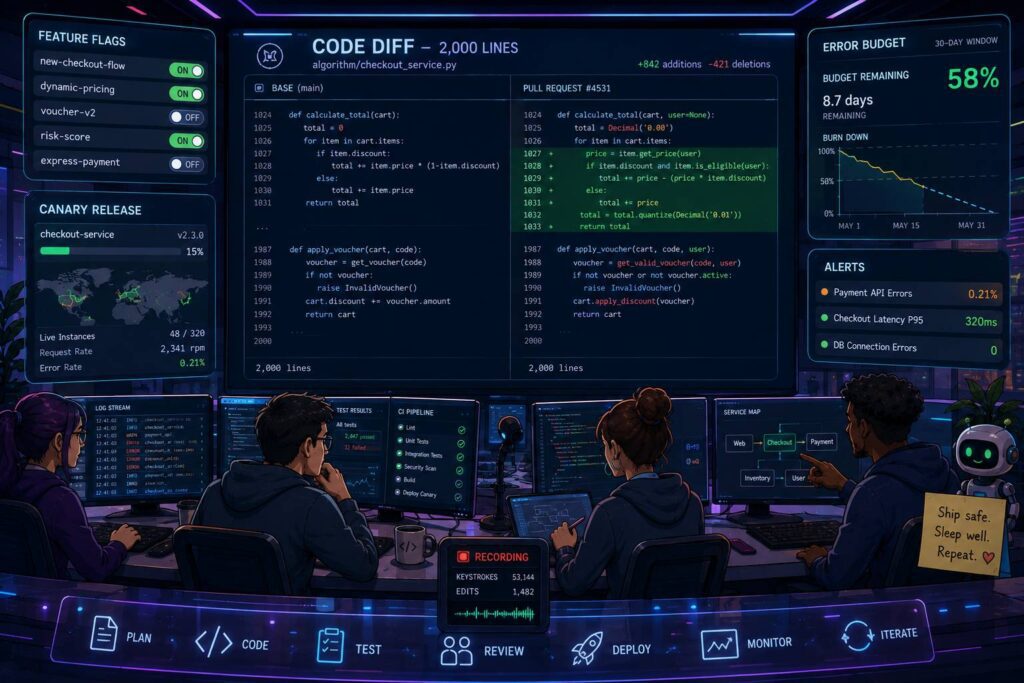
Feature flags are a powerful tool that allow developers to toggle specific features on or off without affecting the underlying code. This means that new features can be rolled out gradually, without disrupting the entire application. Canary releases take this concept a step further, by releasing new features to a small subset of users before rolling them out to the general public. This allows developers to catch any issues before they affect everyone.
Error-budget burn is another technique that runtime can use to its advantage. By tracking the number of errors that occur, developers can understand when to release new features and when to hold back. This is especially useful in high-availability applications where downtime is not an option. Trace comparisons are also an essential tool in catching behavioural regressions. By comparing the logs of different versions of an application, developers can quickly identify any issues that may have been introduced.
Provenance and accountability are also crucial aspects of runtime. By recording model, prompt, and human edits, developers can understand how a particular decision was made. This is especially useful in applications where transparency and explainability are key. By incorporating runtime as the final reviewer, developers can catch issues that may have otherwise gone unnoticed. But it’s not just about blocking bugs and errors – runtime can also serve as a teacher, providing valuable insights into how an application behaves in different scenarios.